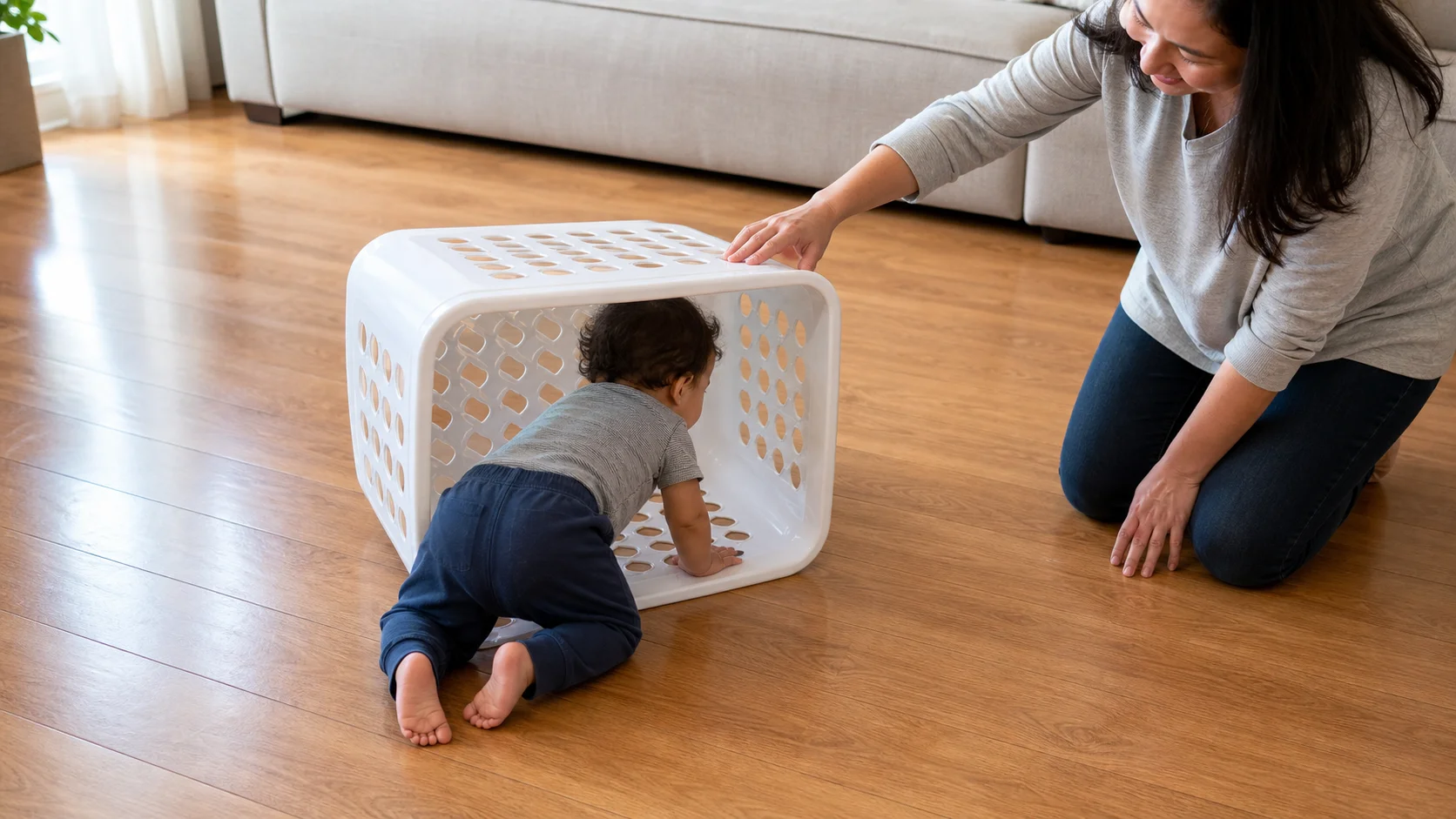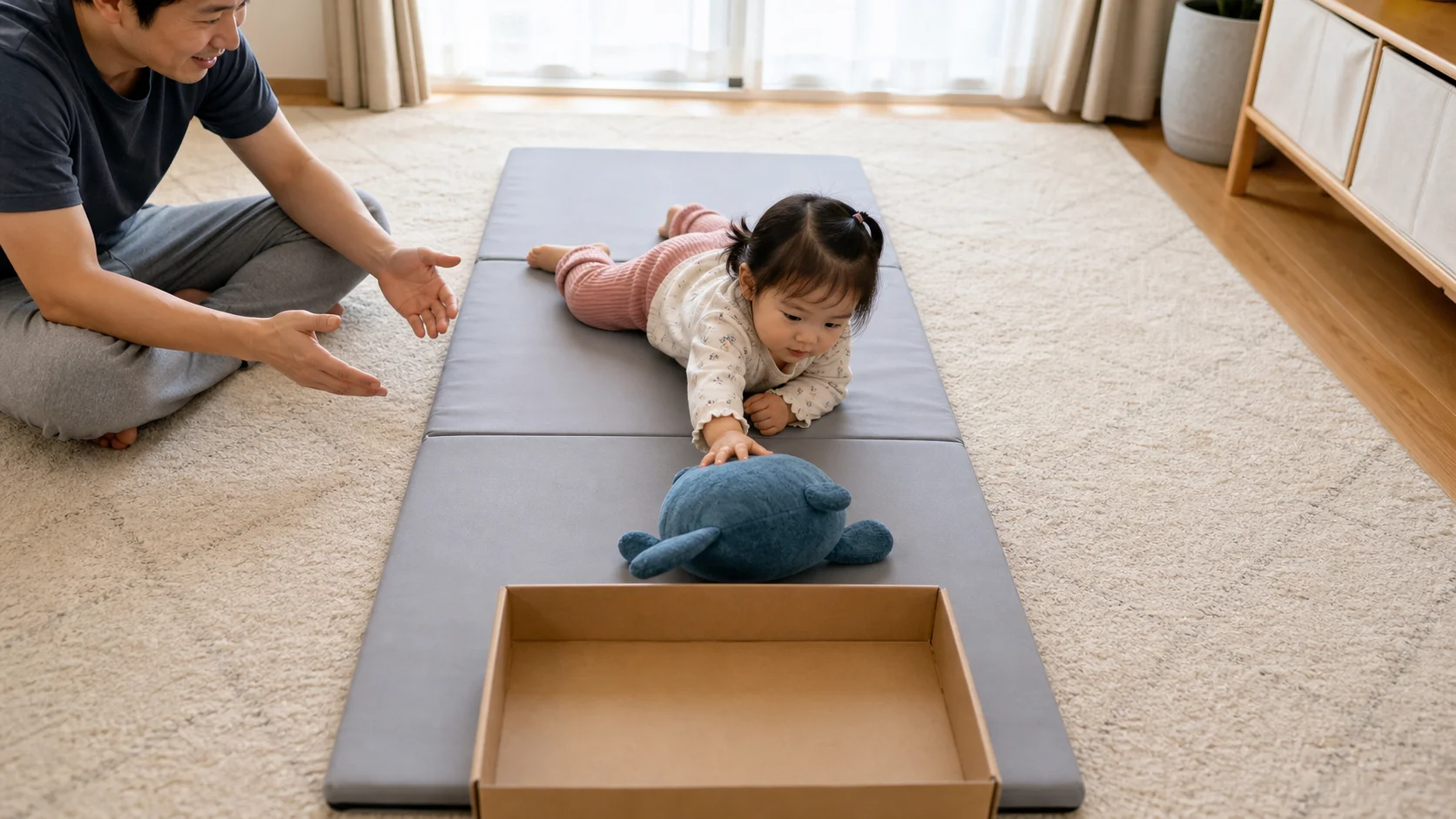
A toddler belly crawling on a soft mat toward a large soft toy with a low rescue box nearby.
Gross motorNavigate PathIndoor

Belly Crawl Rescue.

A soft toy, a short lane, and a box turn belly crawling into a repeatable rescue game.

Play time
5+ min
Age
2-3 years
Energy
Medium
Mess
Low
Effort
Low
Where
Indoor
Start here

The recipe.

Low parent effort
3 things

What you need

  • 1 soft mat, carpet strip, or padded floor space
  • 1 beanbag or 1 soft toy that is too big to fit fully in your child's mouth
  • 1 small box, basket, tray, or other low-sided container
5 min minimum

Setup

Then start the loop
Step 01
Clear 1 soft, straight crawl lane on the floor or on a mat. Make it long enough for a few forearm pulls but short enough that the item still looks easy to reach.
Step 02
Put 1 beanbag or soft toy on the floor at the far end of the lane.
Step 03
Put 1 small box, basket, tray, or other low-sided container on the floor just past the item so your child reaches the item first and then makes 1 short forward move to drop it in.
Step 04
Place your child on their belly at the start of the lane facing the item, and stay beside the lane ready to show 1 forearm pull and reset the item after each turn.
Rescue time.
The loop

How play unfolds.

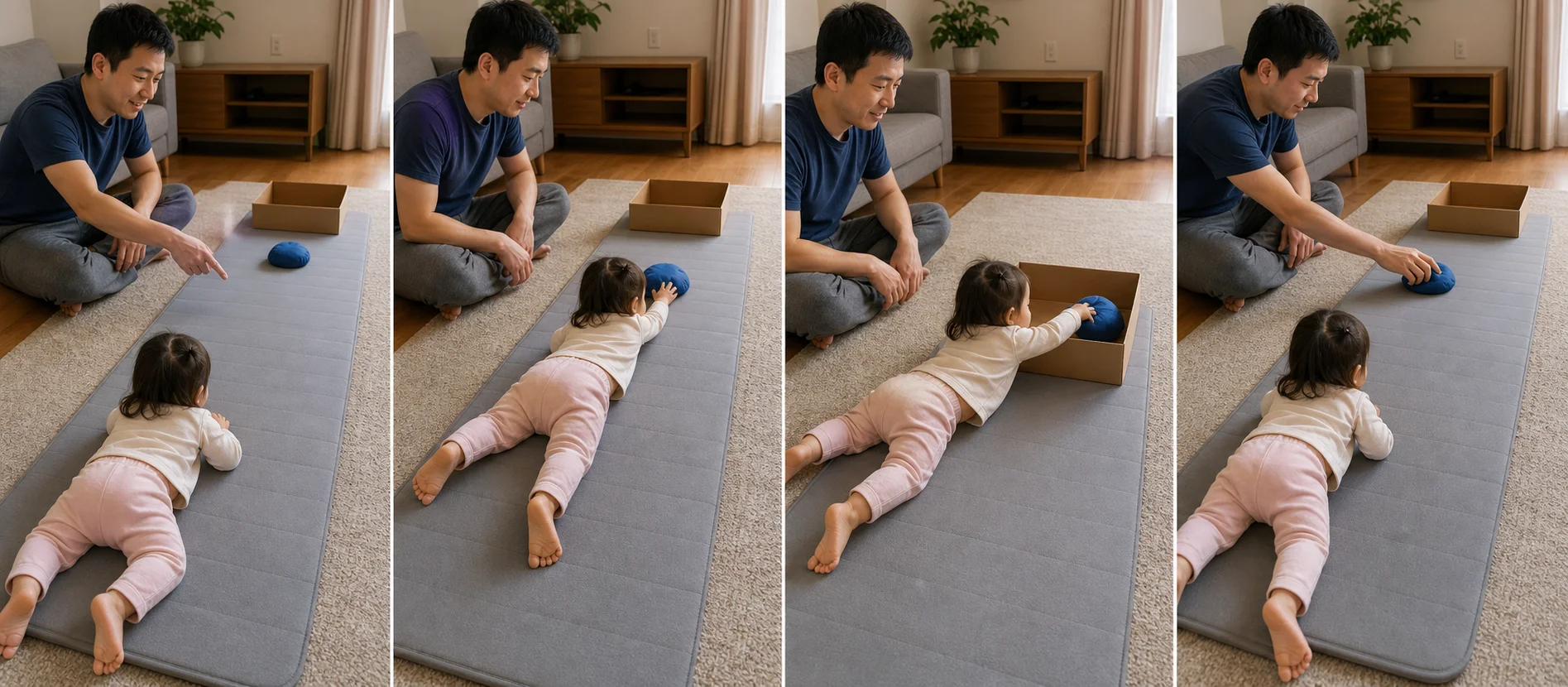
A multi-panel sequence showing a child starting belly-down, crawling to a soft toy, dropping it into a box, and returning to start.
  1. 01
    Start your child on their belly at the lane. Show 1 forearm pull if needed, then say, `Belly down. Rescue it.`
  2. 02
    Let your child crawl on their forearms to the item, pick it up, and drop it in the box.
  3. 03
    Have your child crawl back to the start spot.
  4. 04
    Reset the item and repeat until you get 3 smooth rescues or your child starts to lose interest.

Safety Check

  • Use a soft, obstacle-free lane so your child does not bump face or hands while crawling.
  • Use 1 beanbag or soft toy that is too big to fit fully in your child's mouth.
  • If you use a box or tray, choose a low, smooth edge and keep it just past the item, not close enough to bump during the crawl.
Supporting the play

What to say in the moment

Match what you say to what you see.

Prompt ladder
Level 1 (Start)
Belly down. Rescue it.
Level 2 (Keep going)
Pull, pull, reach it.
Level 3 (Stretch)
Get it to the box.
Level 4 (Extend)
Back to start for 1 more rescue.
If your child seems...
What you'd see
Focused
What to do
Say
You got it.
Add
Ask 1 learning prompt only after the drop, such as `Toy or box?`
Extend
Send the next rescue right away before the energy dips.

Make it easier

Younger end
  • -End after 2 calm rescues instead of aiming for the full round.
  • -Let your child rest the item on the box edge before dropping it in.
  • -Keep your hand near your child's feet as a quiet body cue instead of repeating directions.

Make it harder

Older end
  • +Pause 1 beat at the start so your child waits on their belly before the first pull.
  • +Place the item a little farther down the same straight lane after a successful round.
  • +Let your child crawl back to the start without a point cue before the next rescue.

If it's not working

If you see
If child ignores it
Do 1 full rescue turn yourself with big, slow arm pulls, then shorten the lane so the first reach happens faster.
If you see
If child misuses it
Put the item back where it belongs, guide your child back to the belly start, and keep only 1 rescue item out so the lane stays clear.
If you see
If child gets frustrated
Move the item and box closer for 1 easy turn, celebrate that rescue, and stop there instead of pushing for more.
Skill spotlight
Path Navigation

Belly crawling to the rescue item and back

This helps your child organize a short movement plan, finish 1 whole-body job, and get back into place for the next turn during play and helper routines.

  • Crawling to 1 clear target helps your child organize their body through a short floor path.
  • Dropping the item in the box gives the rescue a visible finish, not just more crawling.
  • Crawling back to start turns the activity into a repeatable loop your child can begin to predict.
Real-world transfer
  • Moving the body through a simple floor path.
  • Finishing a short helper job from start to finish.
  • Returning to a starting spot for another turn in movement games or routines.

Parent questions