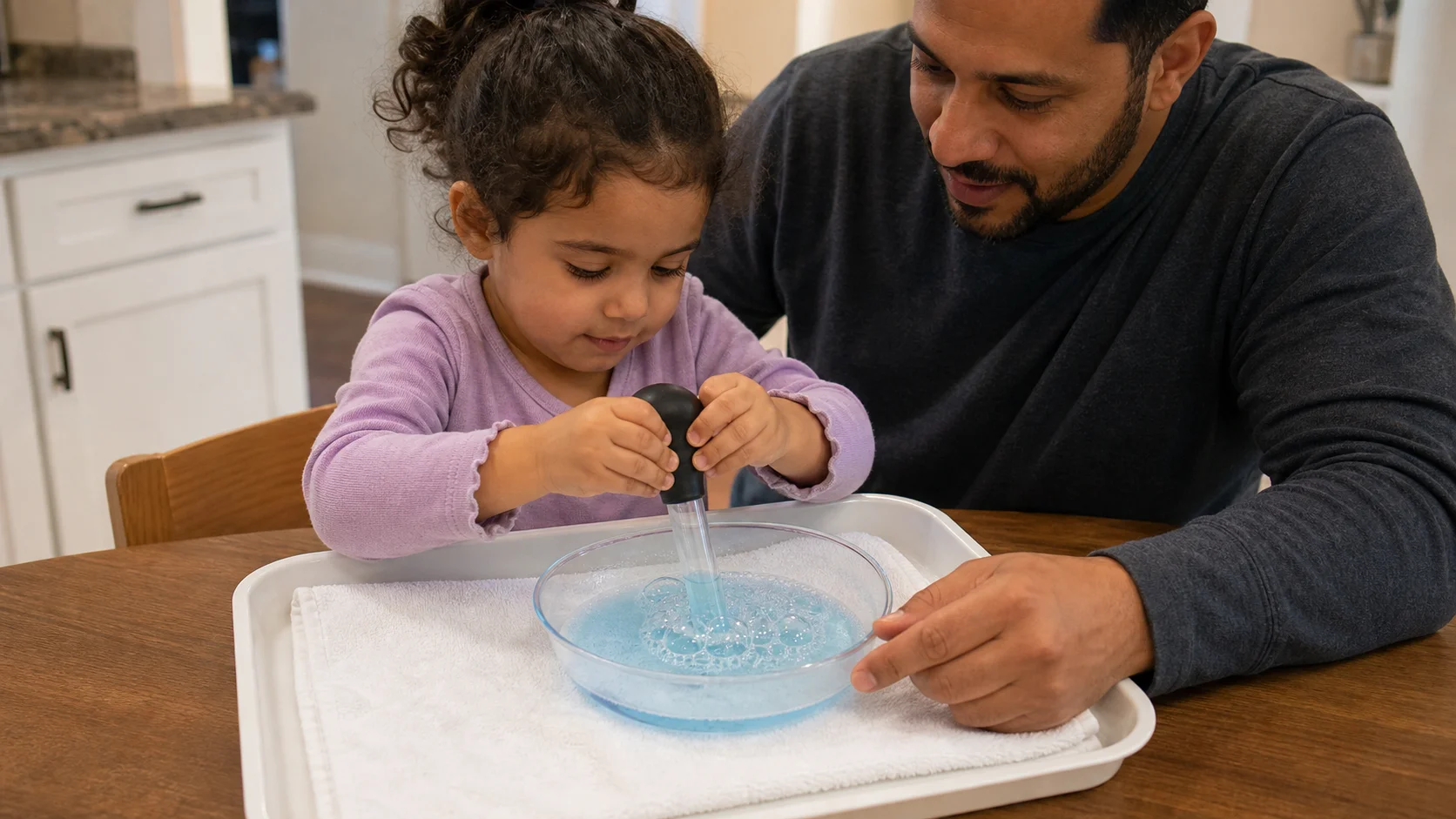
A grown-up supervises as a child squeezes a turkey baster into a shallow bowl of soapy colored water.
Fine motorOT-adjacent supportSqueeze And Release`Indoor

Baster Bubble Bowl.

Dip a turkey baster into soapy water, squeeze for bubbles, and wait for the bulb to puff out before the next turn.

Play time
5-10+ min
Age
2-4 years
Energy
Low
Mess
Medium
Effort
Medium
Where
Indoor
Start here

The recipe.

Medium parent effort
8 things

What you need

  • 1 shallow bowl
  • 1 turkey baster
  • Water
  • A small amount of dish soap
  • 1 to 2 drops of food coloring
  • 1 towel or tray
  • 1 adult
  • 1 child
5 min minimum

Setup

Then start the loop
Step 01
On a steady table or floor spot, place the towel or tray where you can sit right beside your child.
Step 02
In the middle of the towel or tray, place the shallow bowl.
Step 03
In the bowl, add just enough water to cover the baster tip.
Step 04
Into the water, add a small squeeze of dish soap and 1 to 2 drops of food coloring.
Step 05
Stir until the water looks lightly colored and soapy.
Step 06
Beside the bowl, place the turkey baster with the tip pointing toward the bowl.
Step 07
Sit close enough to steady the bowl or take the baster if it goes toward the mouth, eyes, or off the towel.
"Tip in."
The loop

How play unfolds.

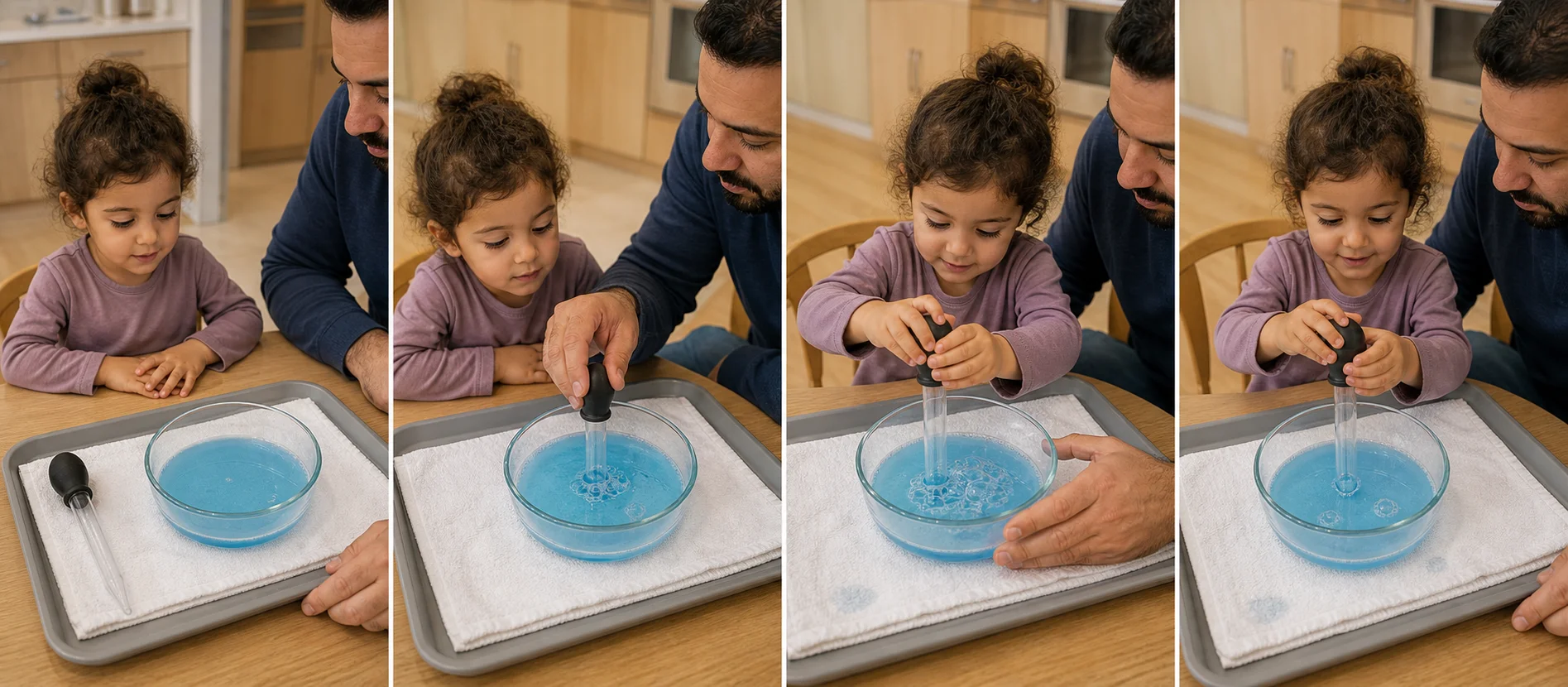
A multi-panel sequence showing the baster tip dipping into water, the child squeezing bubbles, and the bulb puffing out for another turn.
  1. 01
    Put the baster tip under the water, squeeze once so bubbles appear, and say, "Tip in, squeeze, bubbles. Now you try."
  2. 02
    Hand the baster to your child with the bulb puffed out.
  3. 03
    Let your child dip the tip into the colored soapy water and squeeze the bulb.
  4. 04
    Point out the bubbles, then cue the reset: "Let it puff out."
  5. 05
    Repeat while the towel still contains the drips.

Safety Check

  • Use close adult supervision for the whole activity.
  • Keep the soapy dyed water out of your child's mouth and eyes.
  • Keep the food coloring bottle out of reach once the water is mixed.
  • Stop if the child mouths the baster, swings it, or splashes water off the towel or tray.
  • Food coloring can stain skin, fabric, or porous surfaces, so wipe drips right away.
Supporting the play

What to say in the moment

Match what you say to what you see.

Prompt ladder
Level 1 (Start)
"Tip in the water, squeeze, bubbles."
Level 2 (Keep going)
"Let it puff back out, then squeeze again."
Level 3 (Stretch)
"Try a tiny squeeze this time."
Level 4 (Extend)
"Now try one slow squeeze and watch what changes."
If your child seems...
What you'd see
Focused
What to do
Say
"You are waiting for the baster to puff out."
Add
"Show me a tiny squeeze."
Extend
Take turns making tiny bubbles and big bubbles.

Make it easier

Younger end
  • -Hold the narrow part of the baster steady while the child squeezes only the bulb.
  • -Count 1 visible bubble burst as a full turn.
  • -Use parent turns between child turns so the child does not need to refill the baster every time.

Make it harder

Older end
  • +Ask the child to wait until the bulb fully puffs out before the next squeeze.
  • +Challenge the child to make 3 bubble squeezes without moving the tip away from the bowl.
  • +Try a quiet squeeze, then a stronger squeeze, and notice which one makes more bubbles.

If it's not working

If you see
If child ignores it
Make 2 loud, visible bubble squeezes yourself, then offer the baster handle-first and say, "Your squeeze."
If you see
If child misuses it
If the baster goes toward the mouth or eyes, calmly take it back, point to the bowl, and say, "Baster stays in the bowl." If that happens again, end the activity and dump the water.
If you see
If child gets frustrated
Put your hand over theirs for 1 slow squeeze, switch to a two-hand squeeze, or let them watch you make bubbles.
If you see
If no bubbles appear
Lift the tip out of the water, let the bulb puff back out with air, put only the tip back under the surface, and squeeze again.
If you see
If the bowl spills
Pause the game, move the baster out of reach, wipe the towel or tray, and restart with less water.
Skill spotlight
Squeeze Control

Squeeze and release control

This helps with the hand control children use for small tools, feeding tools, art tools, and later cutting practice.

  • Your child has to squeeze, release, and wait for the bulb to puff out before the next turn.
  • The bubbles make the result easy to see, so each hand action has a clear payoff.
  • Keeping the tip in the bowl gives the squeeze a small target and a simple boundary.
  • Missed squeezes can reset quickly by letting the bulb fill with air and trying again.
Real-world transfer
  • Using squeeze bottles or droppers in art
  • Handling feeding tools with steadier fingers
  • Using both hands around small tools
  • Preparing for scissors, hole punches, and other open-close tools

Parent questions