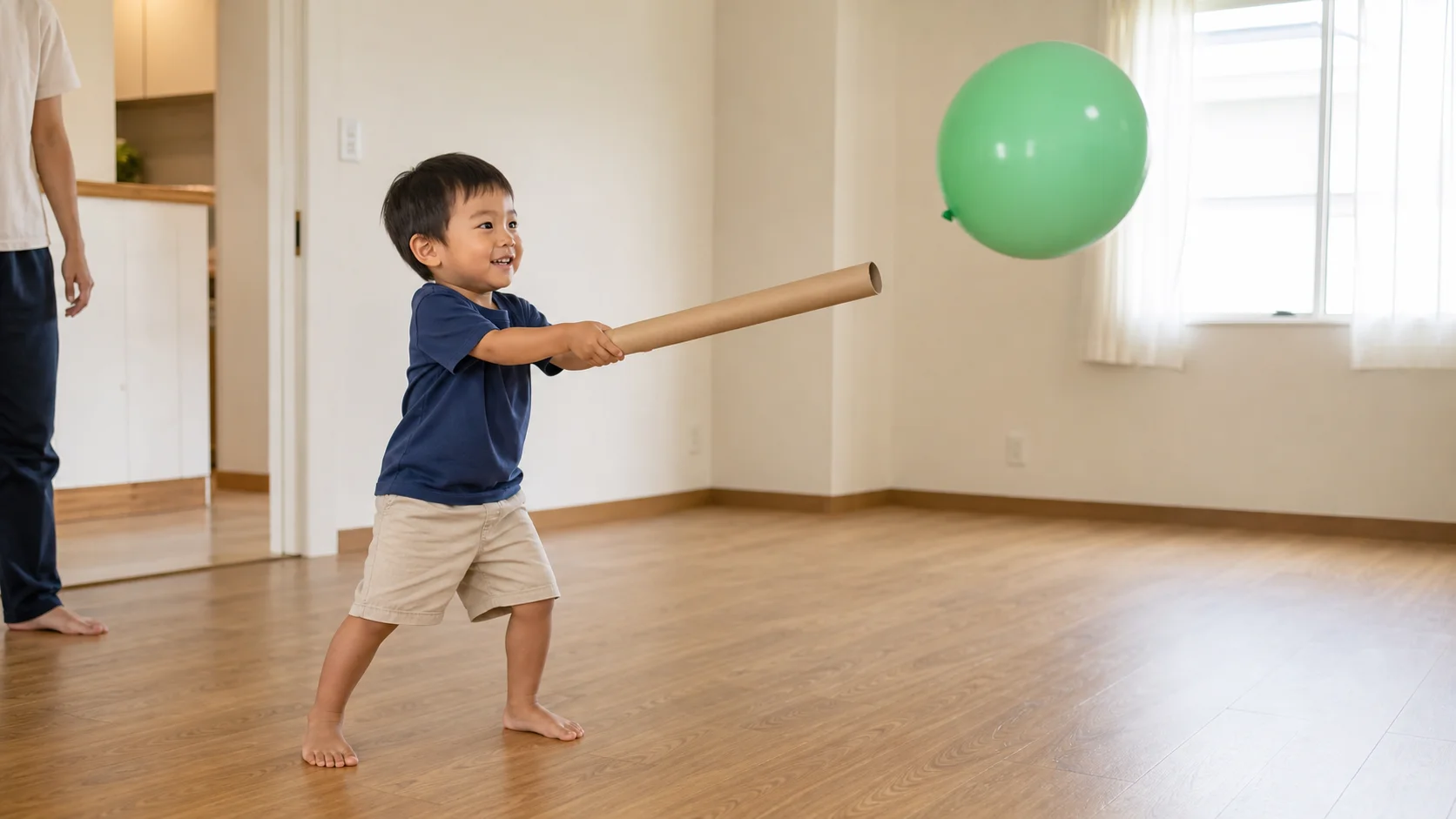
A toddler batting a large balloon with a cardboard wrapping-paper tube in a cleared living room while a grown-up watches nearby.
Gross motorStrike With ToolIndoor Cleared Room

Balloon Batting.

A balloon and cardboard tube become a slow hit-and-chase game for indoor movement practice.

Play time
10+ min
Age
2-5 years
Energy
High
Mess
No Mess
Effort
Low
Where
Indoor Cleared Room
Start here

The recipe.

Low parent effort
4 things

What you need

  • 1 large round balloon
  • 1 empty cardboard tube from wrapping paper
  • Indoor space free of obstacles and valuable breakables
  • Optional: a second cardboard tube for turn-taking
10 min minimum

Setup

Then start the loop
Step 01
In one room-sized play zone, move lamps, pictures, plants, small tables, pets, and breakables out of the space.
Step 02
In the middle of the cleared space, place one large round balloon inflated until it holds its shape and bounces away when tapped.
Step 03
In your hand, hold the empty wrapping-paper tube so your child can see both the tube and the balloon.
"Tap and chase."
The loop

How play unfolds.

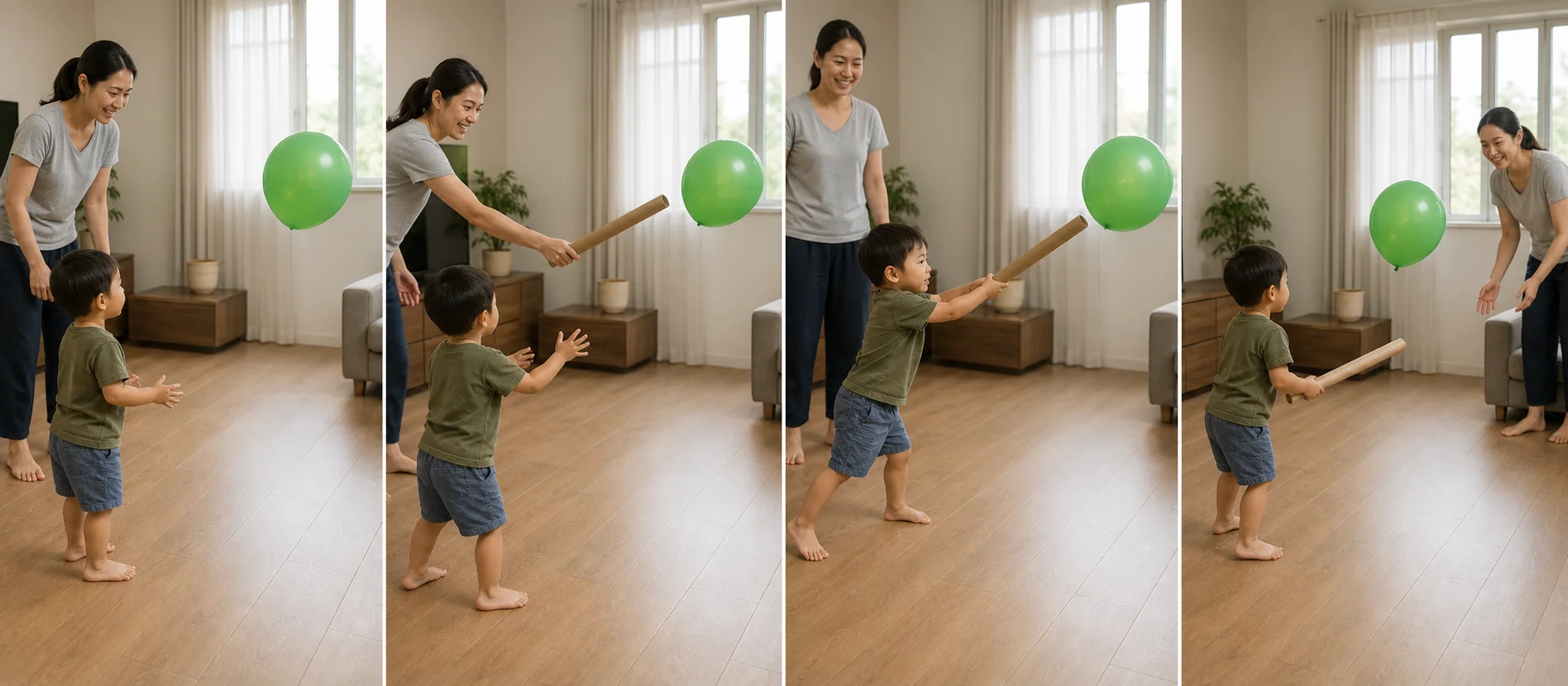
A multi-panel sequence showing a grown-up clearing space, modeling one balloon tap, a toddler hitting the balloon, and the balloon being reset to the middle.
  1. 01
    Tap the balloon once with the cardboard tube and say, "Watch this. I tap the balloon. Now you try."
  2. 02
    Hand over the tube and let your child hit, chase, and hit again.
  3. 03
    Bring the balloon back to the middle when it drifts near furniture, people, pets, or a doorway.
  4. 04
    Stop when your child loses interest, starts swinging at something other than the balloon, or the balloon pops.

Safety Check

  • Stay close while the balloon is in use. If it pops, stop play immediately and throw away every balloon piece.
  • Keep the play zone clear because your child will watch the balloon instead of the room.
  • Use the tube only for the balloon. If your child swings toward people, pets, or breakables, pause and reset.
Supporting the play

What to say in the moment

Match what you say to what you see.

Prompt ladder
Level 1 (Start)
"Tap the balloon."
Level 2 (Keep going)
"Go get it."
Level 3 (Stretch)
"Can you tap it back to me?"
Level 4 (Extend)
"Try a tiny tap this time."
If your child seems...
What you'd see
Focused
What to do
Say
"Watch where it floats."
Add
Name one direction after the hit, like "up" or "across."
Extend
Send the balloon gently back so the child can hit it again.

Make it easier

Younger end
  • -Let the child hold the tube with two hands.
  • -Start the balloon close enough for one sure hit.
  • -Count one hit as a full turn before resetting the balloon.

Make it harder

Older end
  • +Ask for two hits before the balloon touches the floor.
  • +Aim for a soft tap, then a bigger tap.
  • +Try simple turn-taking without catching the balloon.

If it's not working

If you see
If child ignores it
Tap the balloon so it floats slowly toward them, then hand over the tube without explaining more.
If you see
If child misuses it
Calmly take the tube, say, "Tube hits balloon only," move people and pets back, and restart with one gentle model tap.
If you see
If child gets frustrated
Hold the balloon still at chest height for one easy hit, then let it drift only a short distance before the next try.
Skill spotlight
Striking Tools

Hitting a slow balloon with a simple bat

This helps a child line up eyes, hands, and body timing when using one simple tool to meet a moving target during active play.

  • Tapping a slow balloon gives your child a moving target that is easier to track than a fast ball.
  • Chasing the balloon keeps the striking loop active: watch, swing, move, and try again.
  • Misses are built into the game, so your child gets repeated chances without the activity feeling stuck.
  • Resetting the balloon to the middle keeps the target clear and the room boundary visible.
Real-world transfer
  • Lining up eyes and hands for moving-ball play
  • Using a simple tool with better timing and control
  • Staying in an active chase-and-try-again game

Parent questions