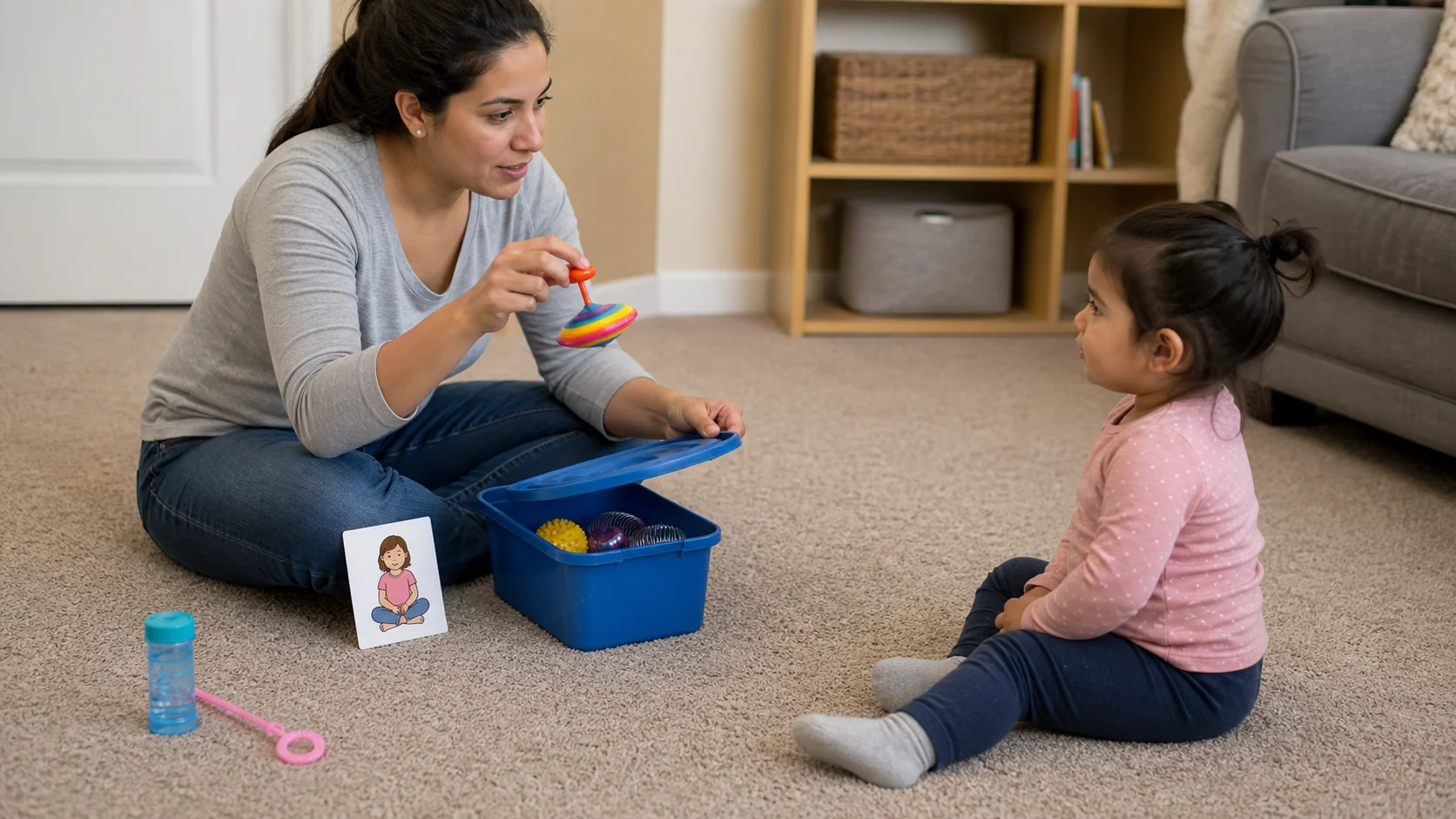
A grown-up sitting across from a toddler and pulling one interesting toy from a small bucket while the child watches closely.
Skill builderSpeech delay supportPause Before ActionIndoor

Attention Bucket.

A few hidden objects and one short reveal at a time turn watching and waiting into a simple home play routine.

Play time
5+ min
Age
1-3 years
Energy
Low
Mess
No
Effort
Medium
Where
Indoor
Start here

The recipe.

Medium parent effort
4 things

What you need

  • 1 lidded bucket, box, or bag
  • 3 to 4 interesting items, such as a wind-up toy, slinky, flashing ball, spinning top, or deflated balloon
  • 1 simple sit cue, such as a sitting picture or familiar sit gesture
  • 1 short motivating finish activity, such as bubbles
5 min minimum

Setup

Then start the loop
Step 01
Inside the bucket, box, or bag, place 3 to 4 interesting items so they stay hidden between turns.
Step 02
On the floor or in 2 facing chairs, sit across from your child with the closed container beside your leg.
Step 03
Near you, keep the sit cue ready and keep the finish activity out of sight until the end.
"Ready. Look."
The loop

How play unfolds.

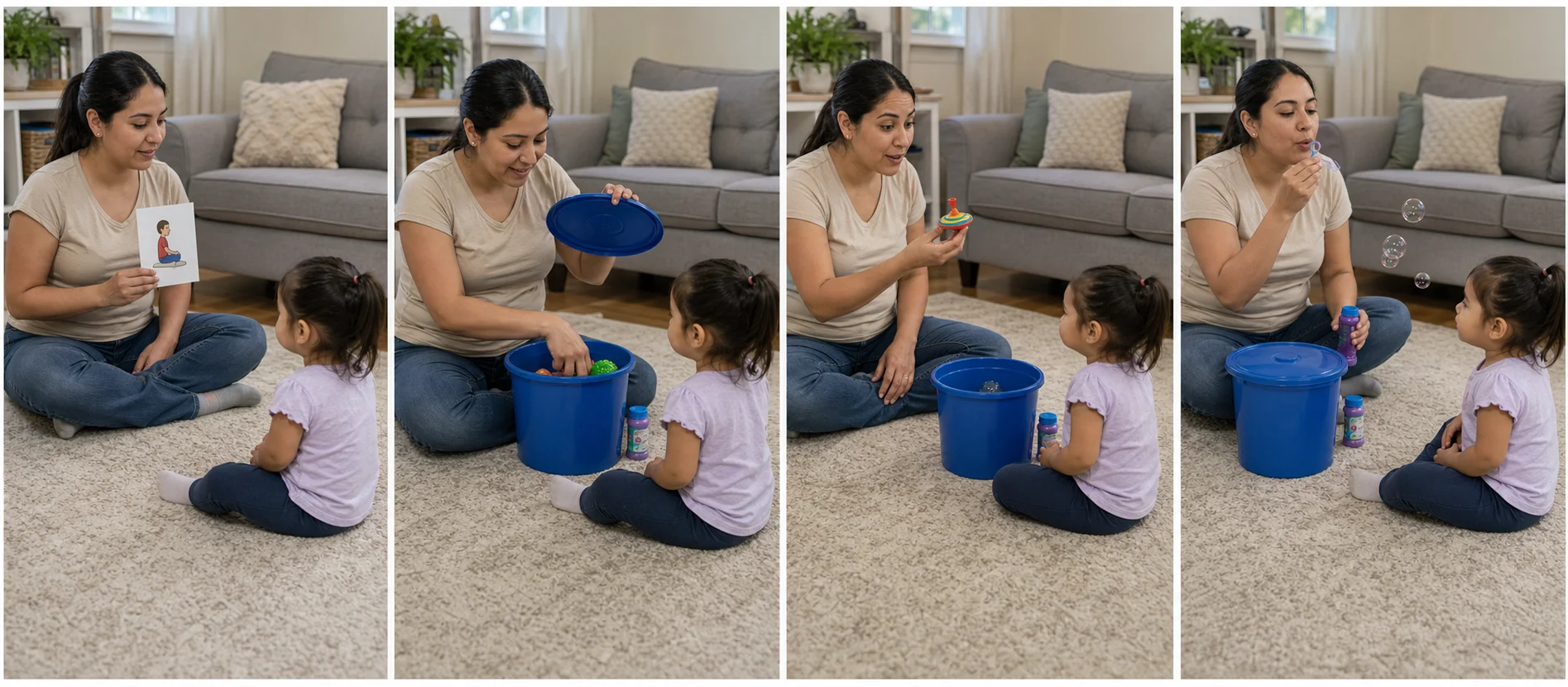
Four panels showing a grown-up filling a bucket, showing a sit cue, revealing one item to a waiting toddler, and ending with a quick reward activity.
  1. 01
    Show the sit cue and say, "Sit with me. Look what is in the bucket."
  2. 02
    Take out 1 item, make it briefly interesting, and let your child watch.
  3. 03
    Put the item back in the container, close or cover it, and reveal the next item.
  4. 04
    If your child reaches for the item, put it away and restart with a calm next turn.
  5. 05
    End after a few reveals or before 5 minutes, then move straight to the finish activity.

Safety Check

  • Stay with your child the whole time.
  • Use only items that are safe for your child's current mouthing and throwing habits.
  • Keep the container in your hands or beside your leg so the child does not grab all the items at once.
  • Stop early if flashing, spinning, or noisy items make your child more dysregulated instead of more focused.
Supporting the play

What to say in the moment

Match what you say to what you see.

Prompt ladder
Level 1 (Start)
"Look what is next."
Level 2 (Keep going)
"One more thing."
Level 3 (Stretch)
"Wait. Here it comes."
Level 4 (Extend)
"Should it spin or bounce?"
If your child seems...
What you'd see
Focused
What to do
Say
"You are watching."
Add
Let the next item do one short action before it goes back in.
Extend
Add a tiny pause before the next reveal.

Make it easier

Younger end
  • -Use only 2 highly visible items.
  • -Make each reveal very short and end before attention drops.
  • -Skip the sit cue once your child already knows the routine.

Make it harder

Older end
  • +Pause for 1 beat before each reveal.
  • +Repeat the same item action twice before putting it away.
  • +Let your child point to the closed bucket to ask for the next turn.

If it's not working

If you see
If child ignores it
Start with the most visually interesting item and make it move right after you say, "Look."
If you see
If child misuses it
Close the container, hold it against your leg, and say, "Bucket stays with me. Watch."
If you see
If child gets frustrated
Do 1 quick reveal, praise the watch, and end with the finish activity instead of stretching the round.
Skill spotlight
Pause Before Action

Waiting for the next reveal, Keeping attention on 1 short adult-led turn

This helps a child practice staying with a short shared routine, holding back from grabbing, and keeping attention on one adult-led moment at a time.

  • Watching one item at a time can make shared attention easier to enter because the rest of the objects stay hidden.
  • The short show-hide rhythm gives your child practice waiting for the next turn without a long demand.
  • Minimal language keeps the focus on the object and the shared moment, not on following lots of words.
  • The clear ending helps some children handle stopping better than a loose open-ended play setup.
Real-world transfer
  • Waiting through one short adult turn before acting.
  • Staying with a brief seated activity or transition cue.
  • Watching for the next step in a simple shared routine.