
Learning through play
You Showed Them One Thing. Did They Think That Was Everything?
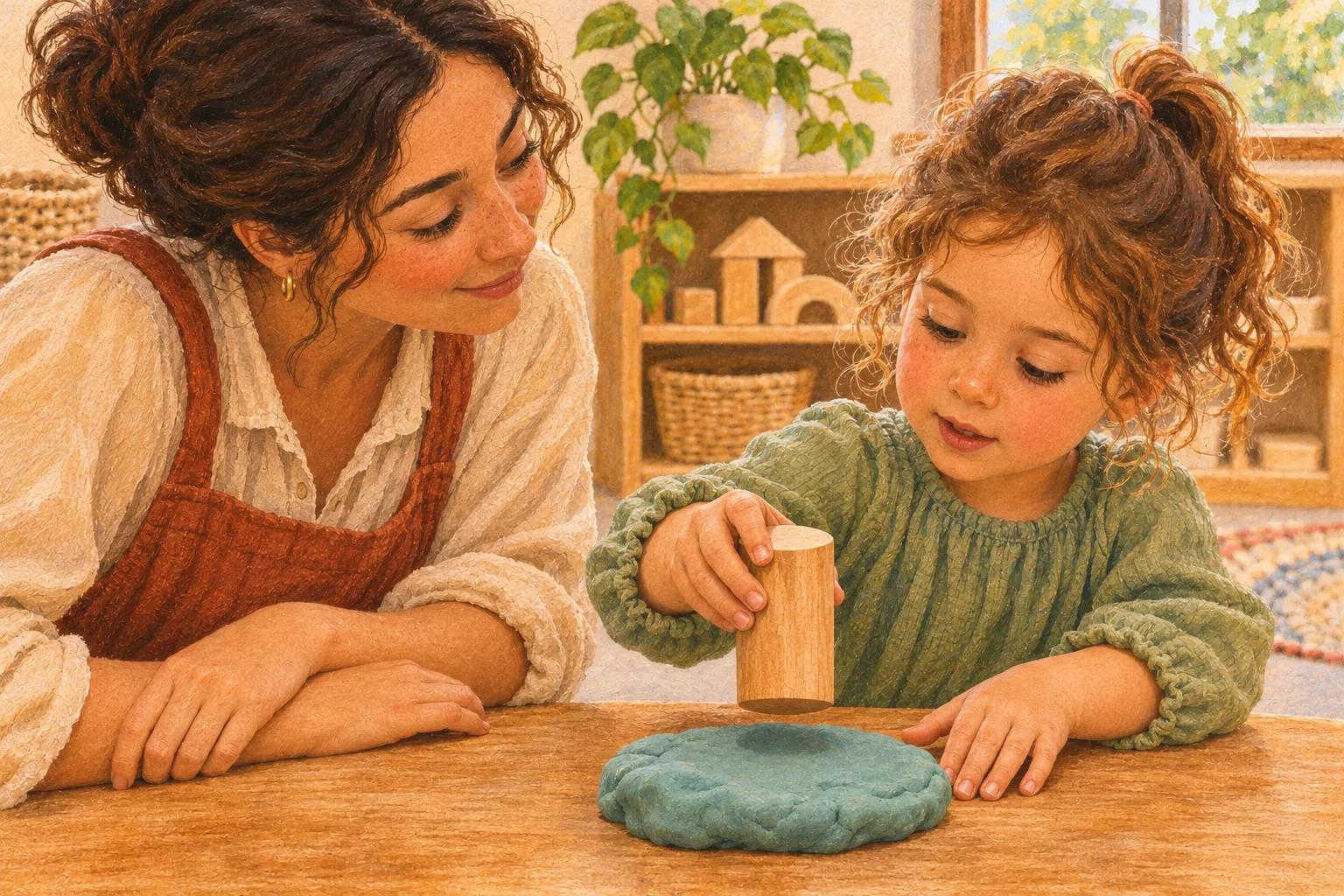
The teacher rolls a short wooden cylinder over a lump of play dough.
“You can roll it like this.”
A child takes the cylinder and rolls it back and forth. The dough spreads into a wide, thin pancake.
The same piece of wood could stamp circles or press grooves into the dough. The teacher has shown one possibility.
Could showing children one way to play make them less likely to discover another?
Elizabeth Bonawitz and her colleagues tested this with a toy that could squeak, play music, light up, and reveal a reflection. Would the way children were introduced to the squeak affect whether they discovered the other features?
Three groups of preschoolers saw a researcher pull a tube to make the toy squeak. For one group, she presented it as a lesson in how the toy worked. For another, she acted as though she had discovered the squeak by accident. For the third, she began teaching but interrupted the demonstration to attend to something else. The children had seen the same feature, presented as a lesson, a chance discovery, or a lesson left unfinished.
Afterward, every child was invited to play and figure out how the toy worked.
Yet in the researchers’ comparison, children who received the teaching demonstration tried fewer kinds of actions and discovered fewer of the toy’s other functions.2
Bonawitz’s team suggested that children might take a teacher’s example as a clue to what there was to discover. If the toy did something else, wouldn’t she have shown them?
Could a teacher help children discover one feature and still leave them looking for others?
In a later experiment, a teacher who had told the children she knew how the toy worked asked them what one of its buttons did. Children learned its function about as successfully as children who saw it demonstrated, while exploring more broadly. The teacher drew their attention to the button and let them discover what it did.3
Before you demonstrate, decide what to leave for children to figure out.
At the play-dough table, another child pulls up a chair. The teacher sets a piece of dough and a wooden cylinder in front of her.
This time, she leaves the cylinder on the table.
“What marks do you think you could make with this?”
The child picks it up and turns it upright.
The teacher waits.
Research and source notes
2. Elizabeth Bonawitz and colleagues (2011), The double-edged sword of pedagogy: Instruction limits spontaneous exploration and discovery, Experiment 1. The study measured immediate exploration of a novel toy, not lasting curiosity or creativity. The proposed explanation of children’s reasoning was an interpretation of their behavior. ↩
3. Yue Yu, Asheley R. Landrum, Elizabeth Bonawitz, and Patrick Shafto (2018), Questioning supports effective transmission of knowledge and increased exploratory learning in pre-kindergarten children. The experiments involved children ages 4–6 and do not establish that questions always outperform demonstrations. Later research by Rebeka Anna Zsoldos and Ildikó Király (2025), Pedagogy Does Not Necessarily Constrain Exploration, also distinguished forms of guidance. Its main corrected contrasts supported differences in action variety, but did not establish differences in total playtime or additional functions discovered. ↩