
Reading together
They Know the Ending. Read It Again.
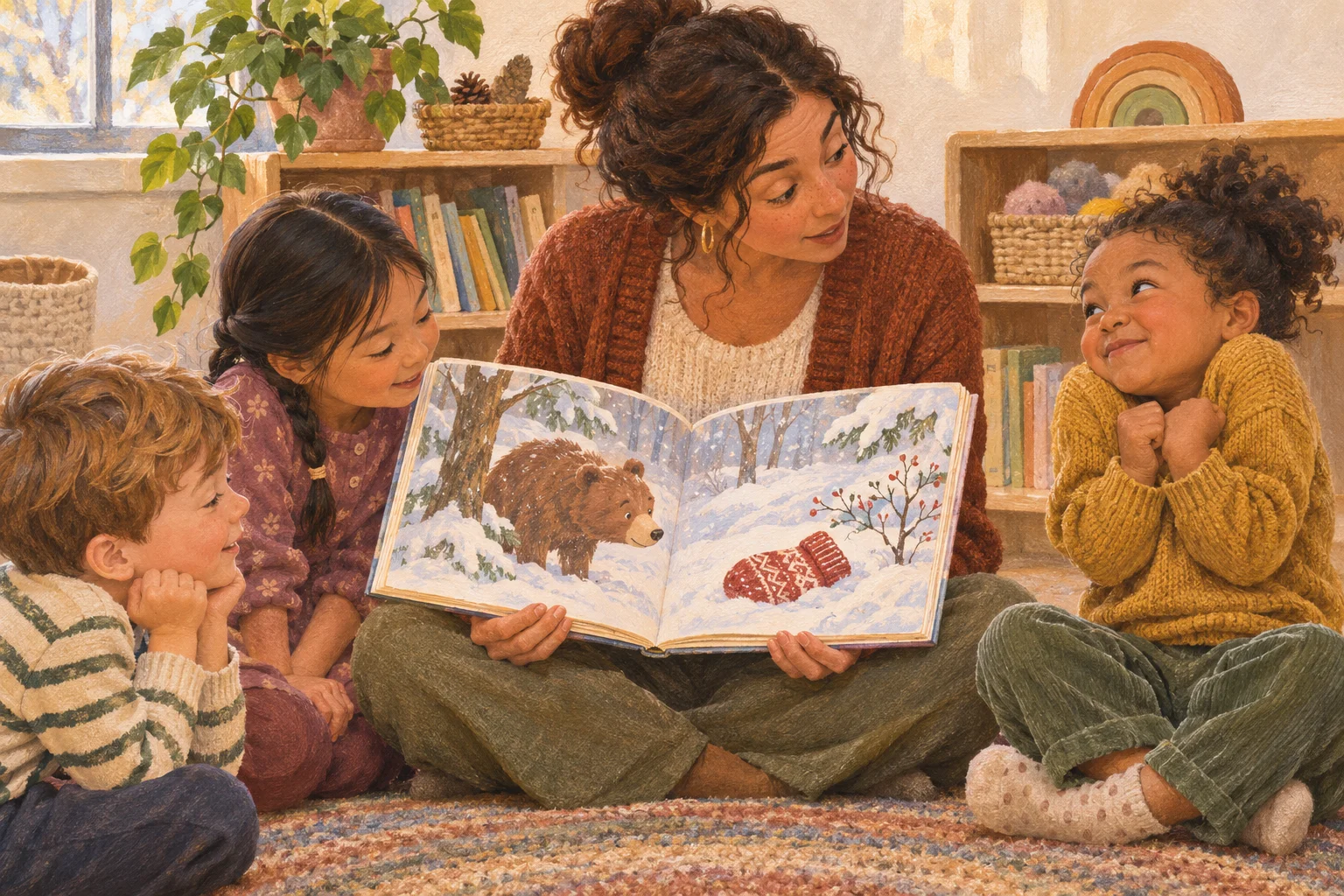
The children are gathered around The Mitten again. They know Jan Brett’s story: a lost mitten, the snow, the animals crowding inside.1 Before the teacher turns the page, a child announces the next arrival.
“Bear!”
Then the picture appears.
“He won’t fit!”
The child knows what happens next and objects anyway. There’s still the question of how a bear could possibly fit inside a mitten.
From the teacher’s side of the book, another reading can look like more of the same. Wouldn’t a different story give children more to learn? Psychologist Jessica Horst’s team tested a version of that question.
Two groups encountered unfamiliar names for objects. And the researchers kept a crucial element the same: every child heard each new name twelve times.
Then came the test: four pictures, a spoken name, and a request to point to the matching object. The children who had heard the same story did better, immediately and on later tests.2
Both groups heard the new words equally often. The advantage came from hearing them in a story that was becoming familiar. Horst’s team thought that knowing what happened next left children with more attention to give the words they didn’t yet know.
Put words to what children show you
The teacher leaves the page open.
“You think there isn’t enough room for him.”
The child looks at the animals already inside, pulls their elbows against their sides, and scrunches their shoulders.
“You’re making yourself small,” the teacher says. “Squeezing in.”
She has put language to an idea the child brought into the conversation. Squeezing describes the action happening in front of her.
She leaves a little space for another contribution, then keeps reading. A bear squeezing into a lost mitten is ridiculous.
The story is familiar enough to anticipate and interesting enough to dispute.
Change what you listen for before you decide the book has nothing left to offer.
If you listen only for names and the correct order, a familiar story will soon sound finished. Listen for what children question, gesture toward, laugh at, or insist upon, and you have somewhere to continue the conversation.
Give books the children want to revisit a regular place in your reading time.
When this child brings The Mitten back, the teacher has a reason to pause at the bear again. The child’s concern about space is something they began together. Returning to it gives the child another chance to point, talk, move, or simply enjoy that impossible squeeze. She can hear what they offer before deciding what to say next.
The book’s ending is settled. Their conversation still has room.
“You thought the bear was too big,” she says. “Let’s look.”
Research and source notes
- Jan Brett’s official page for The Mitten. The classroom scene and dialogue are imagined illustrations, not quotations from the book or reports of an observed classroom. ↩
- Jessica S. Horst, Kelly L. Parsons and Natasha M. Bryan (2011), Get the Story Straight: Contextual Repetition Promotes Word Learning from Storybooks. Later visits introduced new books and words. Children selected pictures of taught objects; spontaneous word use was not tested. ↩