
Art and creativity
Process Art vs. Product Art: What the Finished Picture Doesn’t Show
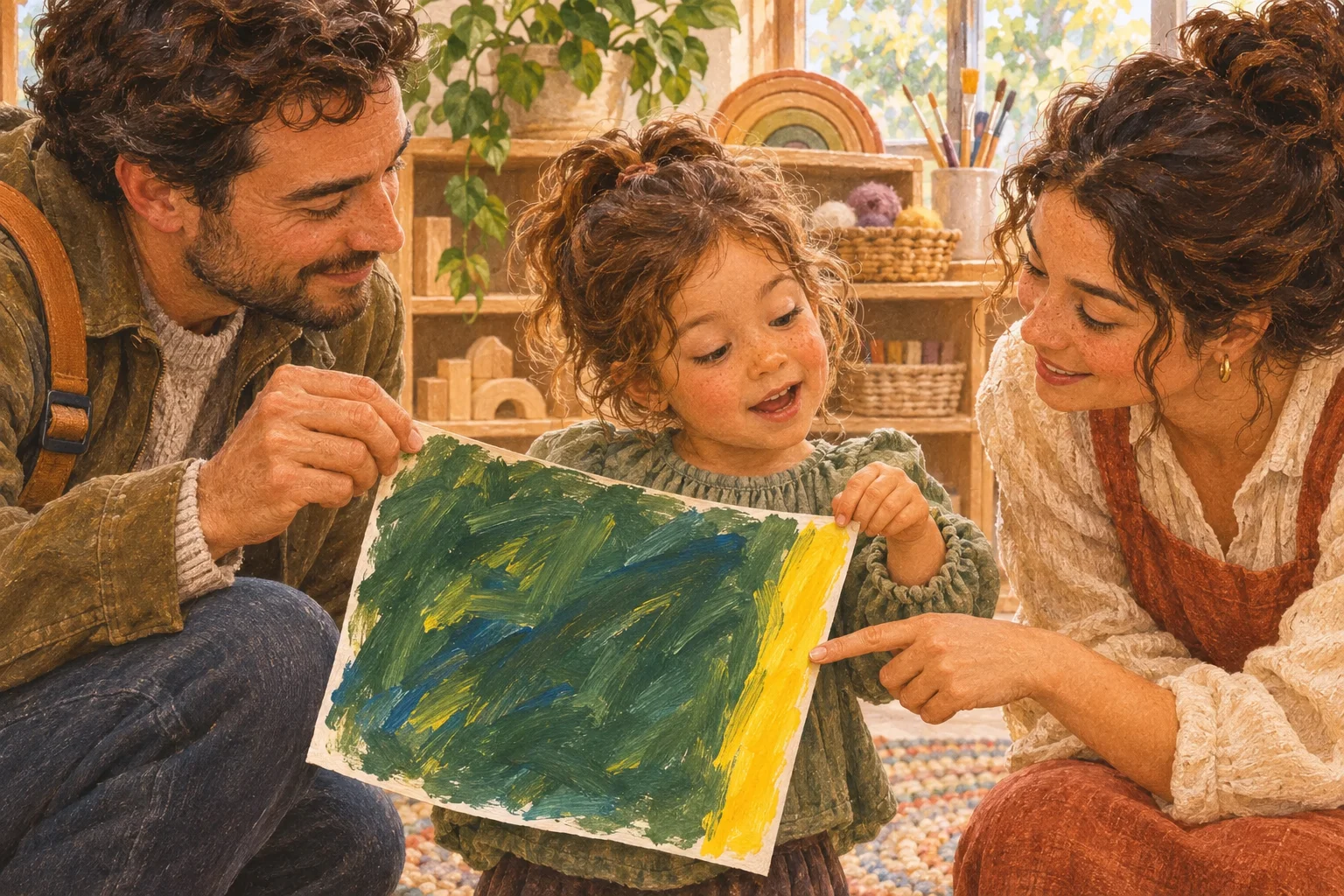
Imagine a child carrying a painting to her dad at pickup. Most of the page is dark green. A stripe of yellow runs along one edge.
“This is for you.”
He takes it carefully. “We’ll put it on the fridge.”
The teacher watched her make it. She remembers the blue spreading into the yellow, the child pausing to look, and the brush moving to a different part of the paper. Her dad has arrived after all of that. He has the painting, but there is something about making it that the teacher can help him see.
To understand the difference between process art and product art, we need to know how the work was made. Process art leaves children room to explore materials and develop their own work. Product-focused art usually asks them to follow a model toward a result decided in advance.1 You cannot always tell which happened by looking at the finished picture.
Consider two children making paper flowers. One copies a flower the teacher has made, using the same colors and arranging the petals to match. The other decides to make a flower for her grandmother, chooses her own colors, and moves the petals around until she finds an arrangement she likes. The finished flowers might look similar. One child followed a design; the other worked out her own.
The finished work can leave out much of what happened while a child was making it. Elizabeth and Andrew Coates explored that missing part of the experience by listening to children as they drew.
They recorded the conversations and joined in as children worked. They kept the drawings alongside notes about what was happening around the children.2
One four-year-old, Sophie, drew a ship. While drawing, she told a story about pirates who had gone away and asked builders to add a telescope so they could find islands with treasure. Much of that story was not apparent in the drawing alone.
A person looking at the finished sheet could recognize the ship and still miss what Sophie was doing with it. The drawing gave her somewhere to develop a story that extended beyond the marks on the page.
Even the idea behind a drawing may still be taking shape as a child works. In another study, four-year-old Ellen drew what she thought school would be like. A dot became a filled circle, then a door. She talked about a friend who had just started school.3
Ellen was working out the story as she drew. The small door became a problem for her friend, so she added a window as another way out. The finished picture could show a school without revealing what led her to add that window.
What children figure out while making art may never show up in the finished picture.
Sometimes a moment from the art table comes up naturally at pickup. A teacher remembers something the child tried, or the child points out a detail.
Parents can begin with a detail they notice: “How did you make these marks?” or “Can you show me what you did here?” A child might name a tool, trace a movement with a finger, or tell a story about what they were making. Let what they offer guide the conversation.
Back at pickup, the teacher points to the yellow stripe.
“She was watching these colors mix. Then she moved over here and left this strip yellow.”
“I wanted to keep that bit,” the child says.
Her dad holds the painting up to take another look.
“Which way up?”
She turns it sideways.
“Like this.”
Research and source notes
1. Laurel Bongiorno (2014), How Process-Focused Art Experiences Support Preschoolers. Professional guidance on process- and product-focused experiences; not a comparative trial of developmental outcomes. ↩
2. Elizabeth Coates and Andrew Coates (2006), Young children talking and drawing, International Journal of Early Years Education, 14(3), 221–241. Author-uploaded text, pp. 225–228. Observational research, not a comparison of process-art and product-art instruction. ↩
3. Johanna Einarsdottir, Sue Dockett, and Bob Perry (2009), Making meaning: children’s perspectives expressed through drawings, Early Child Development and Care, 179(2), 217–232. University-hosted manuscript, Example IV and discussion. ↩