
Classroom jobs
Preschool Classroom Jobs: Give Them Something Real to Do
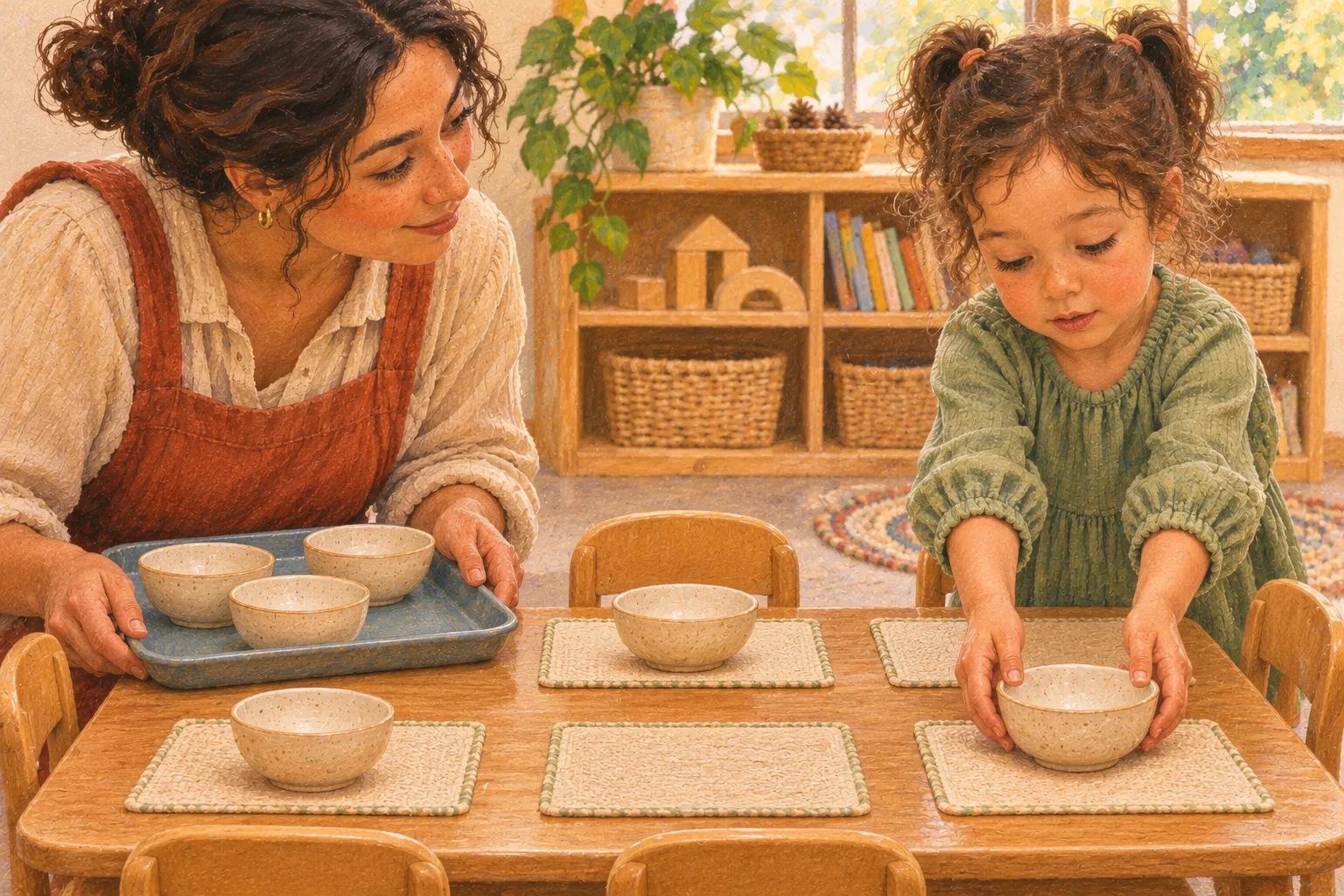
Imagine a teacher setting out bowls for snack. A four-year-old girl comes over from the play kitchen.
“Can I do that?”
There are six places to set, and children are already heading to the sink to wash their hands. The teacher could have the bowls out in a few seconds. Letting the child do it will take longer.
If children can choose between pretending and doing the real thing, which do they prefer?
Jessica Taggart and her colleagues asked 100 children aged three to six to choose between real and pretend versions of nine everyday activities. Each pair of photographs showed the same activity done for real or in pretend play. The researchers asked which the children would rather do and why.
Three-year-olds showed no clear preference. Children aged four to six favored the real activities.1
Children who preferred the real activities often gave practical reasons. Baking would leave them with cookies they could eat. A working phone would let them reach someone. What they could accomplish mattered to them.
We should make room for real jobs in the classroom. Children can value the chance to do something useful. They let children take responsibility for something that needs doing and see how their work helps someone else.
At the snack table, there is something for the child to accomplish, too. The bowls she puts out will be used when everyone sits down to eat.
Give children a manageable part of the actual job, and let their contribution be used.
Look for something that already needs doing, especially something a child has noticed or asked to join. Then choose a part they can carry through with your help. The bowls need to reach the table; the child may only need to carry two at a time.
Keep the parts you need to handle: “I'll carry the tray. You can put the bowls out when I set it down.”
There is room for pretending here, too. The child can call it a restaurant while setting out bowls for an actual meal.
When everyone sits down for snack, they use the bowls she put out.
A few everyday jobs children can help with:
- Help prepare food. Wash vegetables that will be used for snack or lunch.
- Get the table ready. Bring bowls and milk to classmates.
- Help clean up after meals. Wipe tables or sweep up crumbs.
- Return shared materials. Put things where the next child can find and reach them.
- Prepare for rest time. Help put mats in their places.
- Care for classroom plants. Water them when needed. If the program has a garden, harvest vegetables for the kitchen.
Research and source notes
1. Jessica Taggart, Megan J. Heise, and Angeline S. Lillard (2018), The real thing: Preschoolers prefer actual activities to pretend ones, Developmental Science, 21(3), e12582. Author-hosted full text, especially pp. 2–4. Participants were predominantly White, middle-class US children. The study measured stated preferences and explanations, not developmental benefits from classroom jobs. ↩