
Apologies and repair
Preschool Apologies: Let Children Help Make It Right
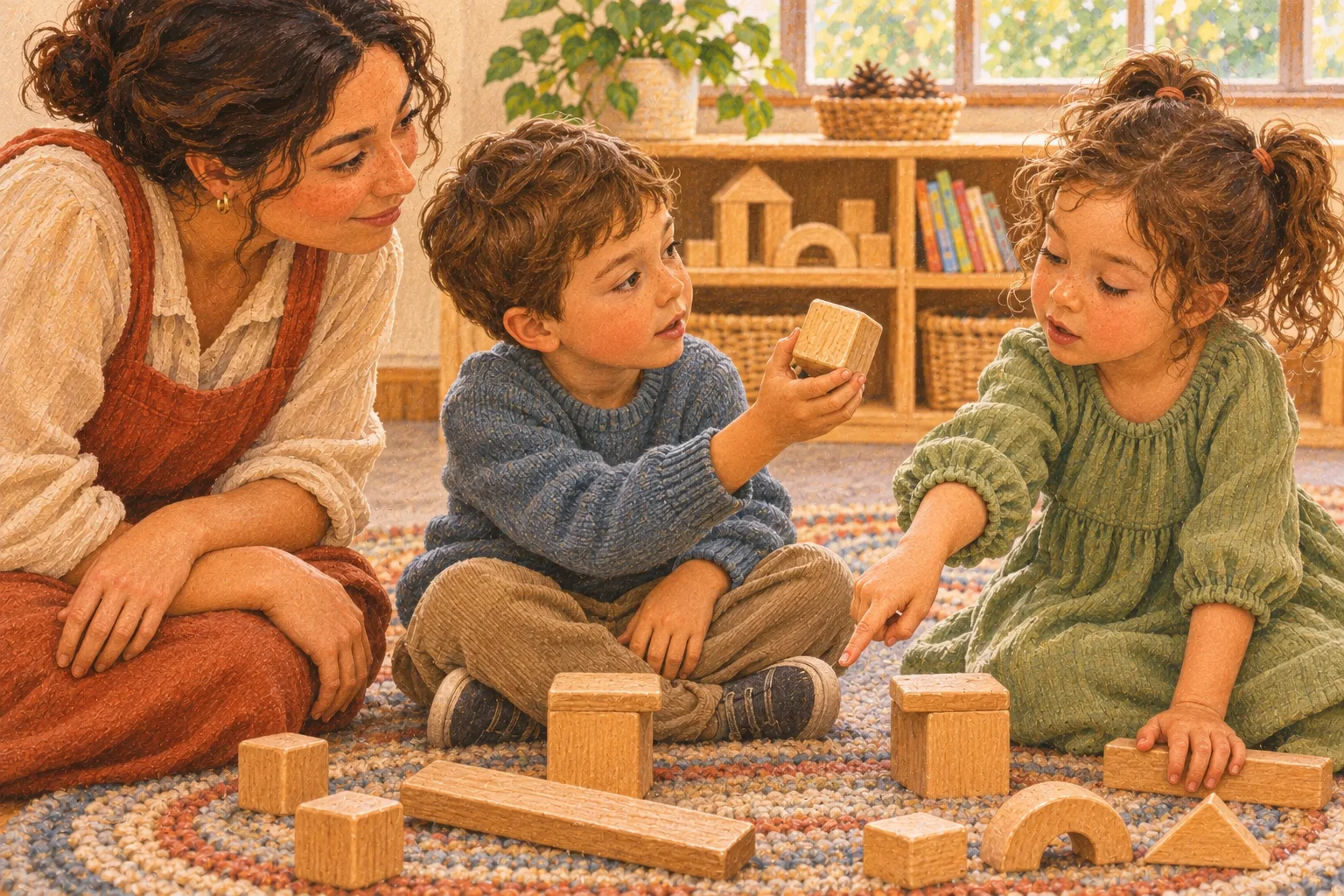
A child knocks down another child's bridge to get one block.
“I was still using that!”
The teacher crouches beside them.
“You knocked down her bridge. Give her back the block and tell her you’re sorry.”
He hands her the block. “Sorry.”
The teacher could gather the scattered pieces and help rebuild. Does it matter if he helps?
Robert Hepach and his colleagues staged a spill in a study of 64 three-year-olds. Some children thought they had caused it. When those children didn't get to help clean up the mess, they showed a stronger physical reaction.1
The researchers concluded that children wanted to help repair the harm they believed they had caused.
Helping repair the harm is part of learning to take responsibility. Children need practice noticing how their actions affect someone else and deciding what they can do to help. Give them a manageable part in the repair, when the other child wants their help, and support them in following through.23
When the children can take part, help them name what happened. You can help them say, “I'm sorry I knocked your bridge down.” Ask what they could do to help. If they aren't sure, give them a few suggestions, like getting a cloth, picking up the pieces, or giving back what they took.2
“Do you want him to help find your blocks?” the teacher asks the girl.
“Yeah. The square ones. Those go on the bottom.”
“I already said sorry,” the boy says.
“I know you did. She still needs her blocks. Do you see a square one?”
He holds up a block. “This one?”
Research and source notes
1. Hepach, Vaish and Tomasello (2017), study, full text, Study 1. The researchers measured the physical reaction through changes in pupil size. Pupil dilation measures arousal, not a specific emotion. When children thought an adult had caused the spill, who handed over the towel made no detectable difference. The study did not measure learning or whether children repeated the behavior. ↩
2. Dan Gartrell (2021), Instead of Discipline, Use Guidance, and practitioner guidance on intent, impact and concrete care from The Child Care Director’s Chair, episode 606 (34:00–36:56). These support adult help with acknowledgment and relevant repair. The imagined bridge scene applies this guidance to deliberate harm; the experiment examined accidents. Classroom recommendations are a synthesis of professional practice and our application, not a tested teaching sequence. Dialogue illustrates possible language. ↩ ↩
3. Suzanne Freedman (2026), What We Get Wrong About Teaching Kids to Apologize and Forgive, informs respect for the recipient's readiness. Its classroom illustration concerns older students. The expectation of supported participation in repair is our teaching stance, informed by the practice sources in note 2. ↩