
Children’s questions
A Good Answer Can Lead to Another Why.
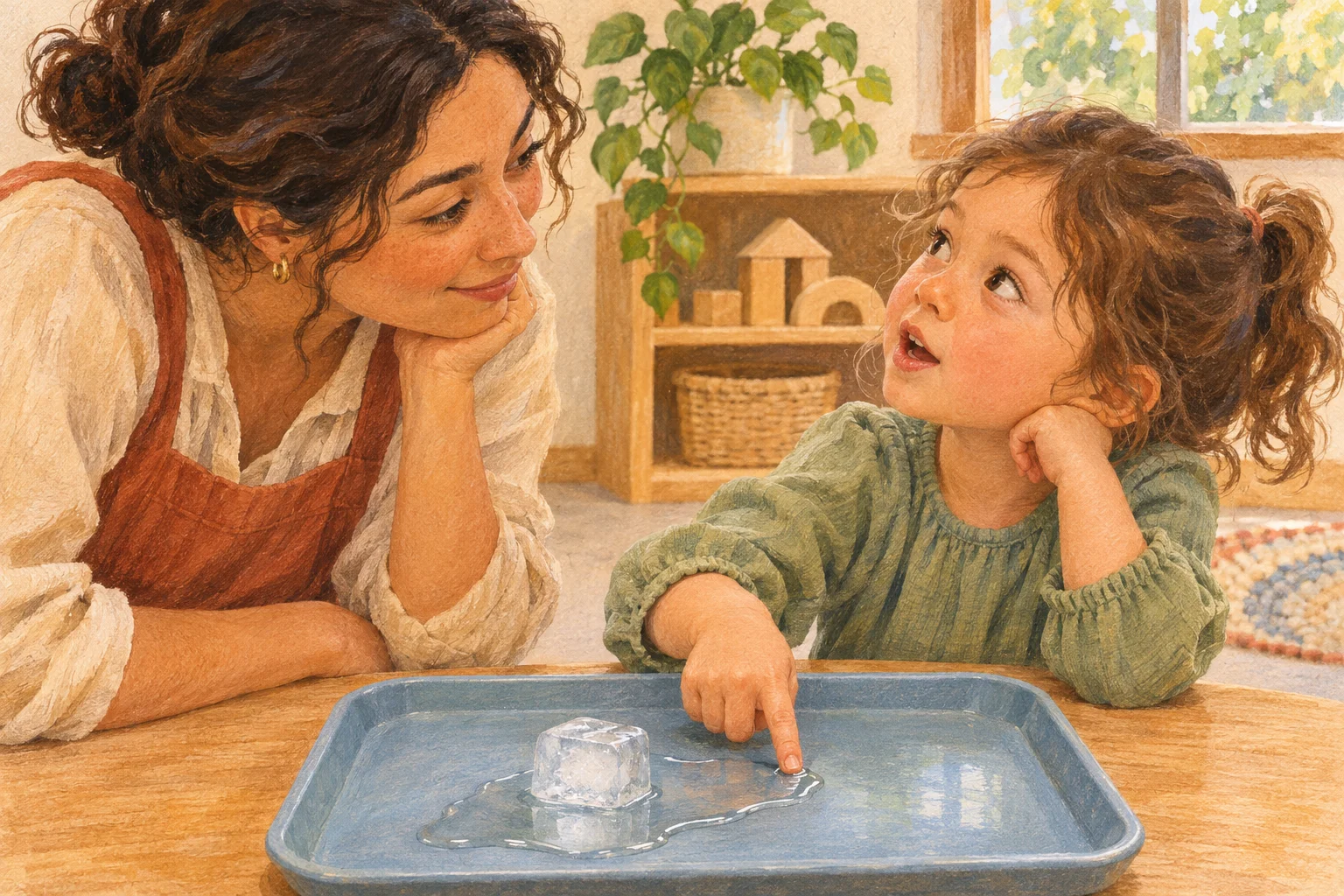
A child watches an ice cube sitting in a puddle on a tray.
“Why is it getting smaller?”
“It’s melting,” the teacher says.
“Why?”
“It’s warm in here. The ice is warming up and turning into water.”
The child looks at the tray.
“Why doesn’t it do that at home?”
The teacher has answered twice. The child is still asking. That can look like an explanation that hasn’t landed.
But what would count as an explanation that had landed? Would the questions stop?
Psychologist Brandy Frazier and her colleagues investigated what children did immediately after an adult answered. They showed preschoolers puzzling things: a hat with a hole in it, a picture of a bed outdoors, a story about a child putting ketchup on ice cream. When children asked about them, the adult sometimes explained what had happened and sometimes offered a comment that gave no explanation.
The explanatory answers were roughly the same length as the other replies.
After a non-explanation, children more often asked their original question again. After an explanation, they more often agreed or asked a new question that built on the answer.1
A useful answer could give the conversation somewhere else to go.
Back at the tray, the teacher has something to clarify.
“The ice in your freezer?”
The child nods.
“The freezer keeps it cold enough to stay ice.”
Now the child is comparing the ice on the tray with the ice in the freezer.
Repeating “It’s melting” would take them back to a question they have already moved beyond.
Before you repeat your answer, make sure the child is repeating the question.
“Why is it getting smaller?” has become “Why doesn’t it do that at home?” The child is using your explanation to think about another situation.
The child runs a finger through the puddle.
“Can we make this ice again?”
“Yes. We can put the water in the freezer.”
The teacher holds a container while the child pours in the water, saving it for the freezer.
A few questions ago, the child was watching the ice disappear. Now they have a plan for bringing it back.
Research and source notes
- Brandy N. Frazier, Susan A. Gelman, and Henry M. Wellman (2009), Preschoolers’ Search for Explanatory Information Within Adult–Child Conversation. The experiment involved 42 children ages 3–5 and measured conversational responses, not comprehension or lasting learning. ↩