Fine motorSqueeze And ReleaseIndoor
Clothespin Dot Match.
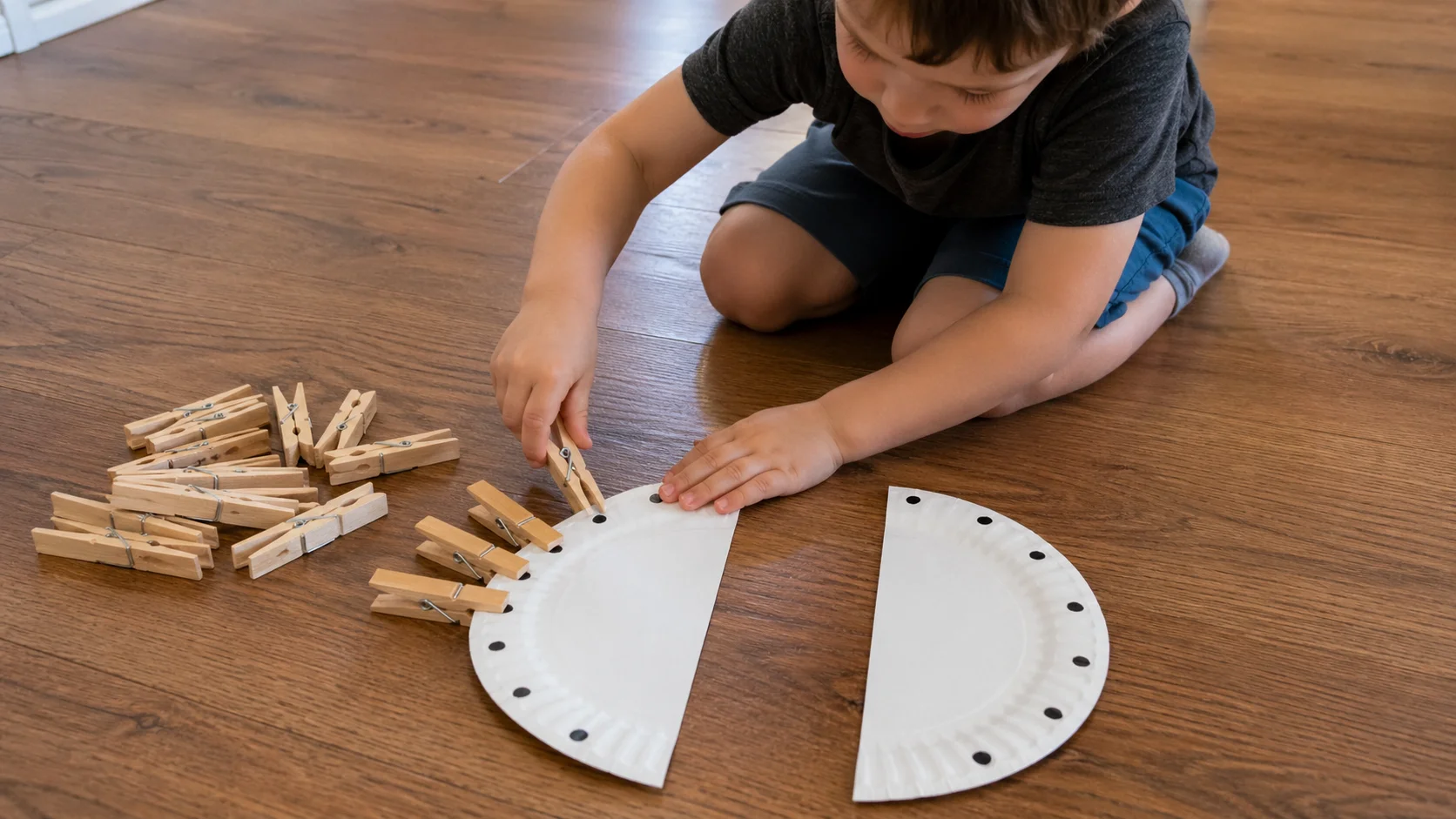
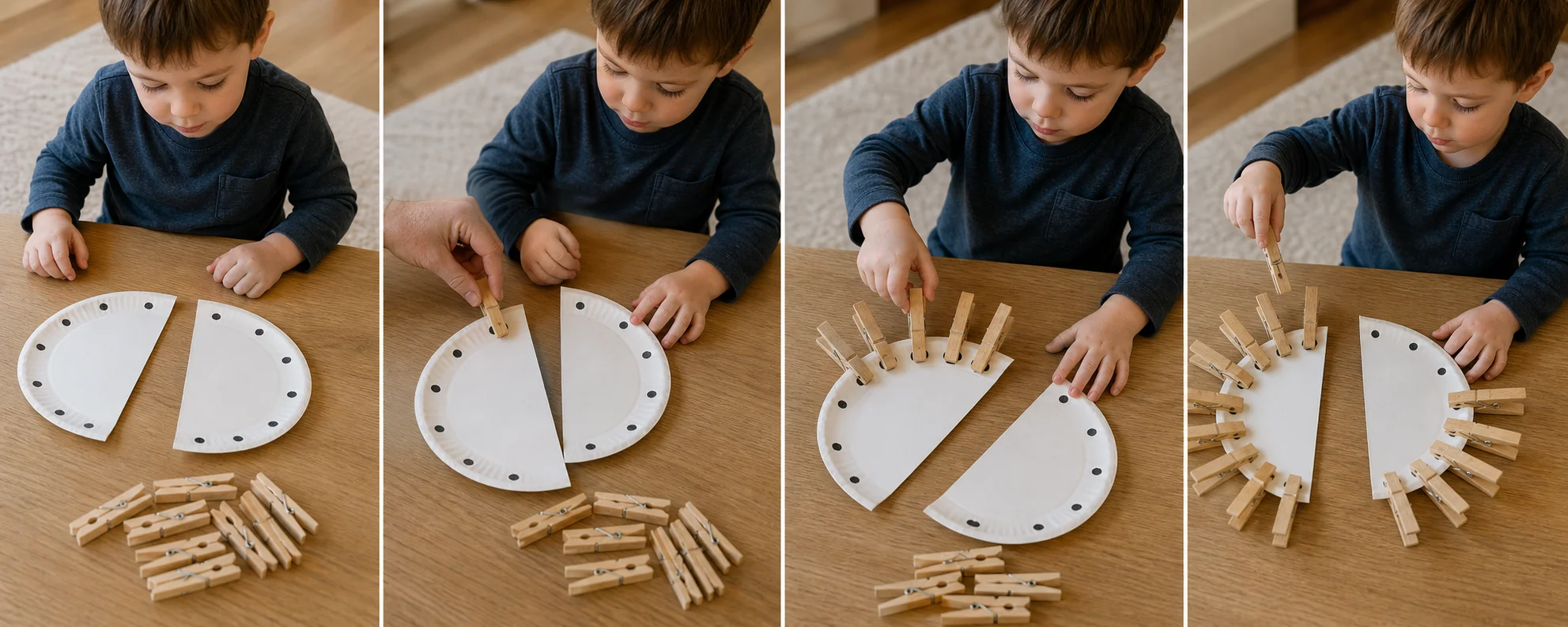
A simple clipping game where your child opens one clothespin at a time and matches it to a dot on the edge of a paper plate.
Cut the plate in half, draw 3 dots on one curved edge, place 3 clothespins beside it, model 1 clip, and let your child fill the remaining dots.
Time
5-15 min
Energy
Low
Parent effort
Low
Age fit
3-5 years
Mess
Low
Location
Indoor

Today's pick
Start here
The recipe.
Low parent effort
4 things
What you need
- 011 paper plate
- 021 marker
- 0312 clothespins
- 04Scissors or another adult cutting tool
5 min minimum
Setup
Then start the loop
Step 01
Cut 1 paper plate in half before inviting your child over.
Step 02
Draw 6 marker dots around the curved edge of each plate half, leaving room for 1 clothespin on each dot.
Step 03
Set the 2 dotted plate halves flat in front of your child with the curved edges facing out.
Step 04
Place 12 clothespins in a small pile right beside the plate halves.
Then continue
Say, "I put the clothespin right on the dot. Your turn."
The loop
How play unfolds.

1
Pick up 1 clothespin, squeeze it open, and clip it directly onto 1 dot while your child watches.
2
Let your child pick up 1 clothespin and try to clip it onto any open dot.
3
After each clip lands, falls off, or misses, point to another open dot and let your child try again.
4
Keep clipping until the dots on both curved edges have clothespins clipped onto them.
What to say in the moment
Match what you say to what you see.
Prompt ladder
Level 1 (Start)
"This dot needs a clothespin."
Level 2 (Keep going)
Point to one open dot and say, "Clip this one."
Level 3 (Stretch)
Say, "Find the next empty dot."
Level 4 (Extend)
Say, "Can you fill this whole edge?"
If your child seems...
What you'd see
Focused
What to do
Say
"Keep clipping."
Add
"How many are on?"
Extend
"Try the next dot without my finger."
Make it easier
Younger end- -Use only one plate half.
- -Start with 3 dots and 3 clothespins.
- -Hold the plate steady while your child clips.
Make it harder
Older end- +Let your child choose the next empty dot.
- +Ask your child to fill one whole curved edge independently.
- +Count each clipped clothespin after it lands.
If it's not working
If you see
If child ignores it
Clip 2 clothespins onto dots yourself, then leave 1 clothespin in your child's hand and point to the next open dot.
If you see
If child misuses it
Pause the pile, hand over 1 clothespin at a time, and say, "Open, dot, clip."
If you see
If child gets frustrated
Start with only 3 dots and 3 clothespins on one plate half, or squeeze the clothespin open together for the next turn.
Skill spotlight
Squeezing and clipping with control
Developmental value
Squeezing and clipping builds finger strength, aim, and controlled release for clothing fasteners, utensils, small tools, and play pieces.
Source support
Pinching, grasping, grip strength, hand-eye coordination, and careful object placement all support the hand-control work children use with tools, clothing, and play materials.
Mechanic evidence
The child picks up one clothespin, squeezes it open, lines it up with a dot, clips it onto the plate edge, releases, and repeats.
Real-World Transfer
- - opening snack clips
- - using tongs or small tools
- - managing clothing fasteners
- - placing small pieces during play
- - helping with laundry clips
What You'll See
Early. Your child needs help opening the clothespin. Your child clips near the dot instead of on it.
Later. Your child fills several dots in a row. Your child shifts the clothespin to cover the dot better.
Middle. Your child squeezes open without help but pauses to aim. Your child retries when the clothespin falls off.
Why it helps
- Opening the clothespin against the spring gives your child repeated squeeze-and-release practice with a clear purpose.
- Matching each clip to one marker dot adds aim and placement after the squeeze.
- Repeating the same clip, release, and try-again loop helps your child adjust after misses without changing the game.
Parent questions
Keep playing
Related play
Activities for ages 3 to 5Fine motor activitiesLow-mess indoor activities