
ThinkingBy ColorIndoor
Card Sorting.
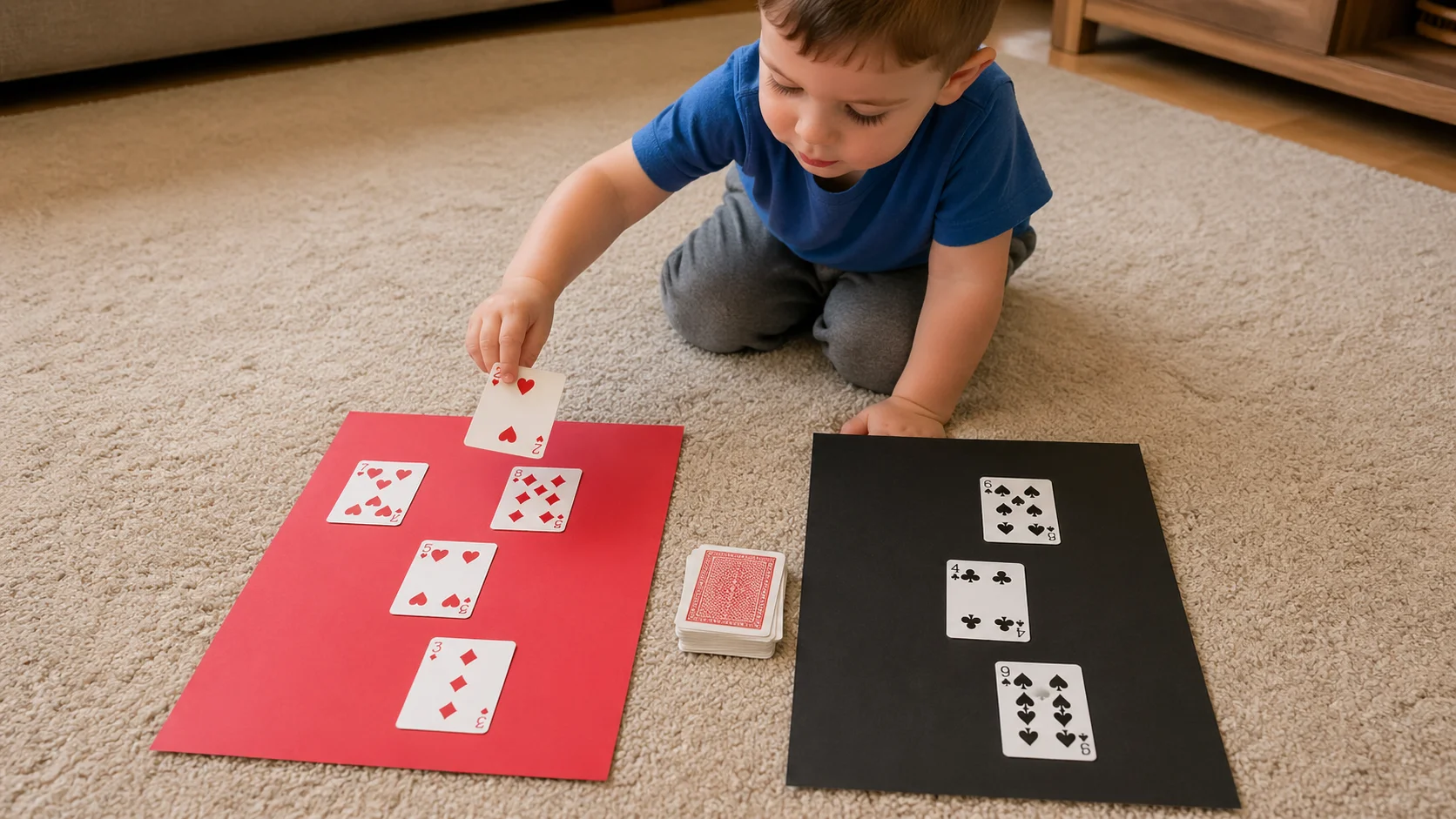
A simple card sorting activity where your child checks each card for red or black and places it on the matching paper.
Put one red paper and one black paper on the floor, pull 8 number cards from the deck, place one example card on each paper, and hand your child the next card.
Time
5-15 min
Energy
Low
Parent effort
Low
Age fit
3-5 years
Mess
Low
Location
Indoor
Today's pick
Start here
The recipe.
Low parent effort
3 things
What you need
- 011 deck of playing cards
- 021 red sheet of construction paper
- 031 black sheet of construction paper
5 min minimum
Setup
Then start the loop
Step 01
Lay the red construction paper and black construction paper side by side on the floor or a low table.
Step 02
Make a small starting stack of playing cards beside the papers. Remove the face cards if the extra pictures feel distracting.
Step 03
Put one red card on the red paper and one black card on the black paper as visible examples.
Step 04
Leave the rest of the starting stack within your child's reach.
Then continue
Say, "This card is red. Can you find where the next card goes?"
The loop
How play unfolds.
1
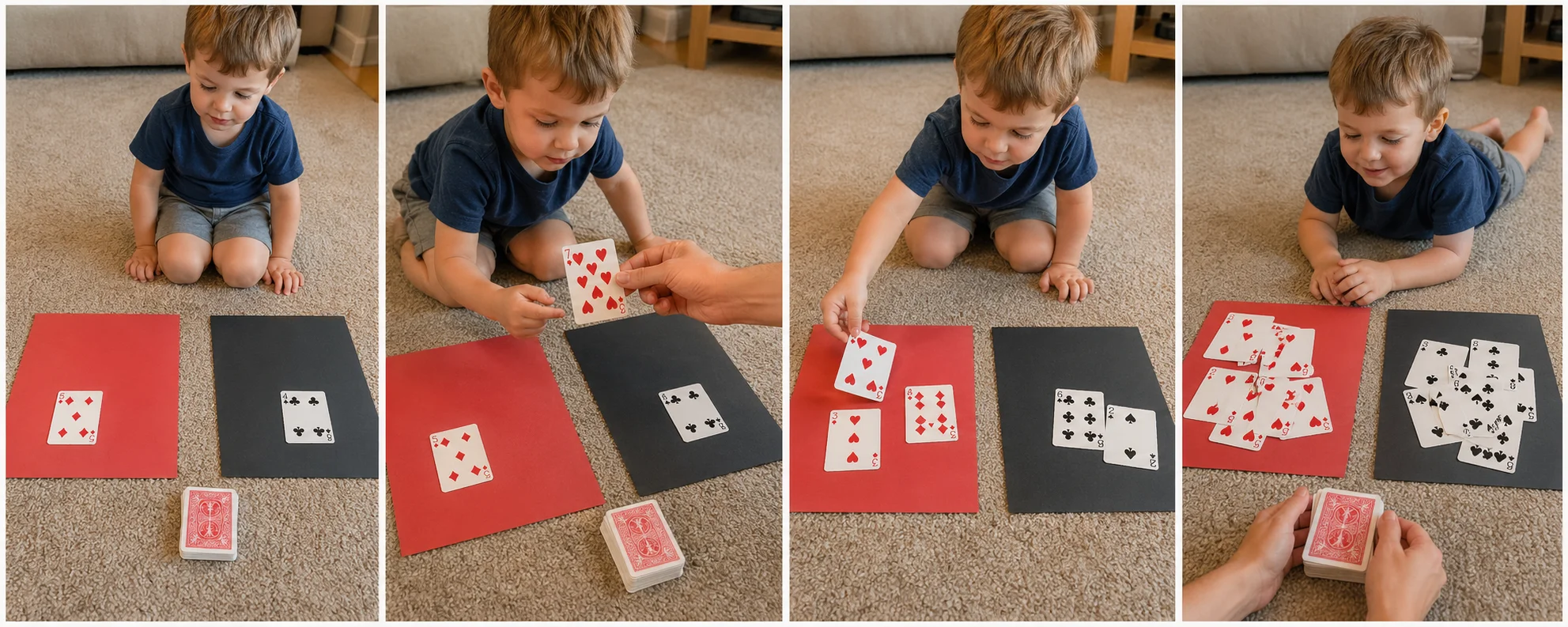
Pick up the top card, point to its color, and place it on the matching paper.
2
Let your child pick up one card, check for red or black, and place it on one of the papers.
3
Name the color only when your child hesitates or asks for help.
4
Keep going until the starting stack is sorted into two piles.
5
Reset by gathering the cards into a small stack or adding a few more unsorted cards.
What to say in the moment
Match what you say to what you see.
Prompt ladder
Level 1 (Start)
Put this card on its color.
Level 2 (Keep going)
Try the next card.
Level 3 (Stretch)
Check the color before you place it.
Level 4 (Extend)
Sort a few more cards.
If your child seems...
What you'd see
Focused
What to do
Say
"You found the match."
Add
Name the card color after your child places it.
Extend
Add a few more unsorted cards to the stack.
Make it easier
Younger end- -Use a smaller stack of number cards.
- -Keep one example card on each paper.
- -Hand over one card at a time.
Make it harder
Older end- +Add more cards after the first stack is sorted.
- +Leave the face cards in if the pictures are not distracting.
- +Let your child fix a misplaced card before the next turn.
If it's not working
If you see
If child ignores it
Sort the first two cards out loud, then hand your child one obvious card and ask, "Red or black?"
If you see
If child misuses it
If cards are being bent, scattered, or mouthed, reduce the stack to 3 cards and hand over one card at a time.
If you see
If child gets frustrated
Remove face cards, use only 6 to 10 number cards, and place one matching example on each paper before trying again.
Skill spotlight
Sorting by color
Developmental value
Sorting by color helps your child notice one feature, choose where something belongs, and group like things together in daily routines.
Source support
Sorting by one visible attribute, such as color, gives children practice placing like items into sets before they try more than one feature at a time.
Mechanic evidence
The child picks up one card, looks for red or black, matches it to the same-color paper, places it, and repeats.
Real-World Transfer
- - putting toys with matching toys
- - sorting laundry by light and dark
- - finding where a household item belongs
- - noticing same and different during play
What You'll See
Early. Your child waits for you to point or name the color. Your child places one card, then looks back at you.
Later. Your child sorts several cards in a row. Your child notices a wrong-color card and moves it.
Middle. Your child pauses to check the card before placing it. Your child makes a few misses but keeps going.
Why it helps
- Checking each card for one feature at a time helps your child practice noticing color before acting.
- Choosing between two landing spots gives your child repeated practice with matching and simple sorting.
- Fixing a misplaced card keeps the rule clear without changing the materials or adding a new step.
Parent questions
Keep playing
Related play
Activities for ages 3 to 5Sorting activitiesLow-mess indoor activities