ThinkingFit InsideIndoor

Block Puzzle.

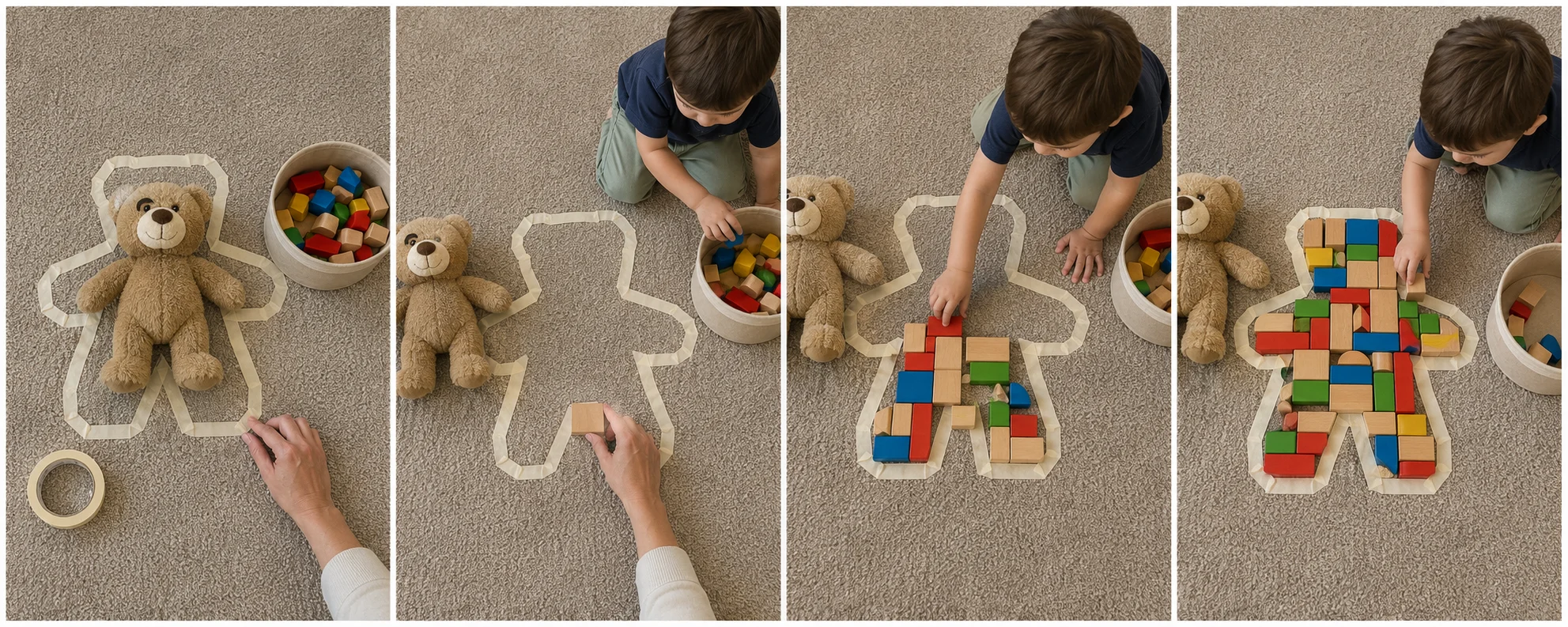
A simple floor puzzle where your child fills a taped stuffed-toy outline with blocks until the open spaces are covered.

Tape a simple oval or rectangle around the stuffed toy, move the toy aside, put 5 to 8 blocks next to the outline, and fill only that small shape.
Time
5-15 min
Energy
Low
Parent effort
Low
Age fit
2-4 years
Mess
Low
Location
Indoor
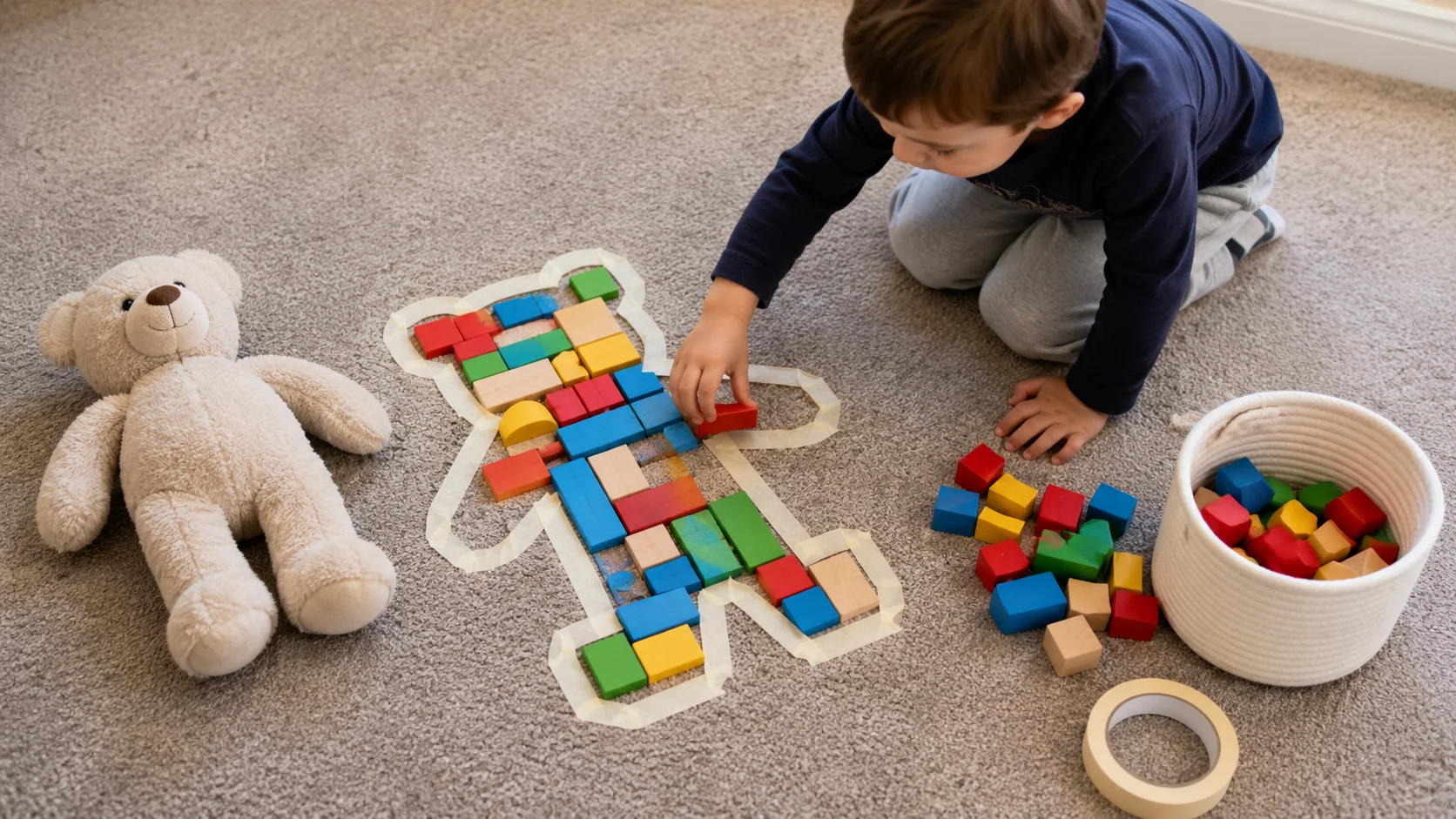
A child placing blocks inside a masking-tape outline of a stuffed toy on the floor.
Today's pick
A taped toy outline gives blocks a clear place to go.
Start here

The recipe.

Low parent effort
3 things

What you need

  1. 01
    1 favorite stuffed toy
  2. 02
    Masking tape
  3. 03
    Multiple blocks; wooden blocks, Duplo, or Mega Bloks work
5 min minimum

Setup

Then start the loop
Step 01
Ask your child to choose 1 favorite stuffed toy.
Step 02
Lay the toy flat on a clear floor space with the ears, arms, and legs spread out.
Step 03
Make a roomy masking-tape outline around the toy so it could fit back inside without touching the tape.
Step 04
Lift the toy out and place it right beside the taped outline.
Step 05
Put a pile of blocks next to one side of the outline where your child can reach them without sitting on the tape.
Then continue
Say, "Let's fill your toy shape with blocks."
The loop

How play unfolds.

Four panels showing a stuffed toy outlined with tape, the toy moved aside, a child placing blocks inside the shape, and the outline filling with blocks.
1
Place 1 block inside the taped outline and slide it toward one edge.
2
Let your child pick up 1 block from the pile and place it inside the shape.
3
Encourage your child to turn, slide, or nudge the block to cover open space.
4
Keep adding blocks until the outline looks filled with no big empty spaces.
5
If a block lands in the middle without helping much, point to one open edge and let your child try moving it there.
6
To reset, move the blocks back into a pile beside the outline and fill the shape again.

What to say in the moment

Match what you say to what you see.

Prompt ladder
Level 1 (Start)
"This shape needs a block."
Level 2 (Keep going)
Point to 1 open space and say, "This spot needs a block."
Level 3 (Stretch)
Ask your child to turn 1 block until it fits better.
Level 4 (Extend)
Clear the shape and fill a different part first.
If your child seems...
What you'd see
Focused
What to do
Say
"Keep filling the open spaces."
Add
Ask, "What color is this block?"
Extend
Start again and choose 1 area to fill first.

Make it easier

Younger end
  • -Fill only the biggest open spaces first.
  • -Use fewer blocks for 1 short round.
  • -Start with the widest part of the outline.

Make it harder

Older end
  • +Fill along the tape edge before filling the middle.
  • +Ask your child to rotate 1 block before placing it.
  • +Count blocks as they go in, 1 prompt at a time.

If it's not working

If you see
If child ignores it
Put 1 block in the outline, hand your child the next block, and point to an open space.
If you see
If child misuses it
If blocks are thrown or kicked, pause the turn, move the blocks back into a small pile, and restart with 1 block placed gently inside the outline.
If you see
If child gets frustrated
Use fewer blocks, cover only one easy part of the outline, or say, "Find a big empty spot."
Skill spotlight

Fitting blocks inside a space, Careful block placement

Fit Inside
Developmental value

Fitting and placing practice helps with puzzles, putting toys into bins or drawers, and setting everyday objects where they belong.

Source support

The block-filling loop is already tied to fine motor skills, hand-eye coordination, and problem-solving; the supporting hand-skill guidance also fits block play, careful toy positioning, and object manipulation for this age range.

Mechanic evidence

The child picks up 1 block, places it inside a visible tape boundary, then turns or slides it to cover open space.

Real-World Transfer
  • - Fitting toys into bins or drawers.
  • - Placing puzzle pieces into a board.
  • - Putting cups, blocks, or shoes where they belong.
What You'll See
Early. Your child places blocks inside after you show the first move.
Later. Your child adjusts blocks and fills more of the outline without reminders.
Middle. Your child starts using the edge or a big gap as a target.
Why it helps
  • Filling a taped boundary gives your child practice noticing where a block can go, not just dropping it anywhere.
  • Turning and sliding blocks inside the outline adds controlled hand movement after each placement.
  • Resetting the shape and filling it again repeats the same spatial problem in a simple, visible way.

Parent questions

Keep playing

Related play

Activities for ages 2 to 4Indoor thinking activitiesBlock play activities