Gross motorNavigate PathIndoor

Bean Bag Hopscotch.

A taped hopscotch path turns one bean bag into a toss, move, retrieve, and repeat game.

Tape three large squares in a row, put one bean bag at the start, and play "toss, walk, pick up, bring back" for 30 to 60 seconds.
Time
5-15 min
Energy
Medium To High
Parent effort
Low
Age fit
2-4 years
Mess
Low
Location
Indoor
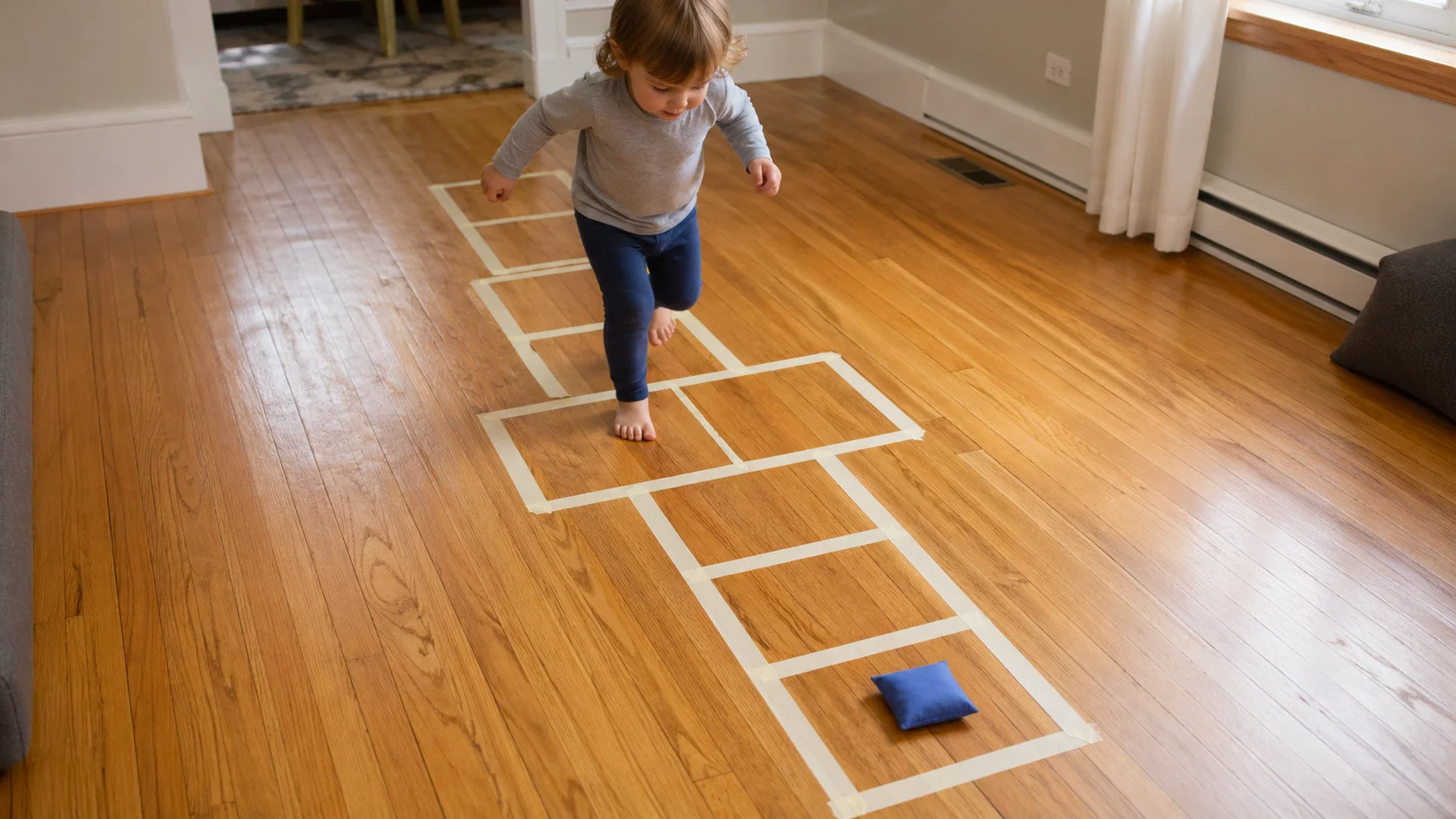
A child tossing a bean bag onto a masking-tape hopscotch path on an open indoor floor.
Today's pick
Tape squares and one bean bag create a quick indoor toss-and-move path.
Start here

The recipe.

Low parent effort
4 things

What you need

  1. 01
    1 roll of masking tape
  2. 02
    1 or more bean bags
  3. 03
    1 open indoor floor area
  4. 04
    1 tape measure or 1 paper guide cut to a 10-inch square, optional
5 min minimum

Setup

Then start the loop
Step 01
Clear a floor path long enough for your child to toss, move forward, pick up the bean bag, and turn around without bumping furniture.
Step 02
Tape a short hopscotch path on the floor with single squares and at least one side-by-side pair.
Step 03
Make each square roomy enough for your child's foot to land inside.
Step 04
Use the tape measure or 10-inch paper square if you want evenly sized boxes.
Step 05
Put the bean bag at the start of the taped path and press down any tape edges that are lifting.
Then continue
Give the bean bag to your child for a turn.
The loop

How play unfolds.

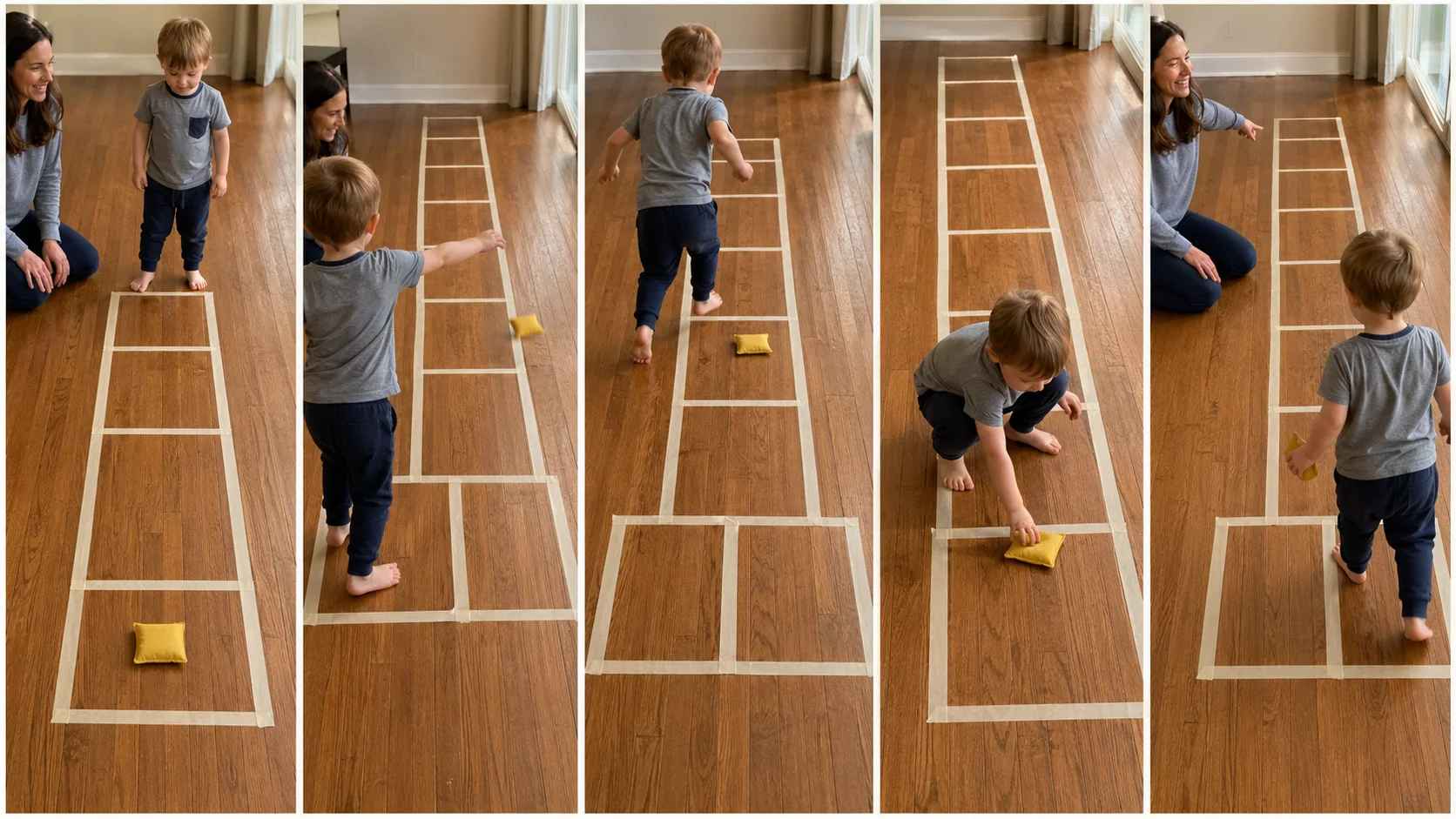
Four panels showing a child tossing a bean bag, stepping through taped squares, picking it up, and returning to the start.
1
Stand at the start, toss the bean bag gently onto the nearest square, and say, "Can you get the bean bag? Step on the tape boxes and pick it up."
2
Your child tosses the bean bag onto a taped square.
3
Your child moves through the path, using one foot on single squares and two feet on side-by-side squares, or walking steps if hopping is too hard.
4
Your child picks up the bean bag, brings it back to the start, and tosses again.

What to say in the moment

Match what you say to what you see.

Prompt ladder
Level 1 (Start)
"Can the bean bag land on this close square?"
Level 2 (Keep going)
"Can it come back to the start?"
Level 3 (Stretch)
"Can it reach the next square?"
Level 4 (Extend)
"Pick your target before you toss."
If your child seems...
What you'd see
Focused
What to do
Say
"Back to start."
Add
Name one square while your child is already moving.
Extend
Let your child choose the next target square.

Make it easier

Younger end
  • -Use only the first 2 or 3 squares.
  • -Let every square be a walking square.
  • -Place the bean bag on the closest square after a missed toss.

Make it harder

Older end
  • +Ask your child to choose a target square before tossing.
  • +Add one one-foot hop on a single square.
  • +Try a slower toss that lands inside the tape lines.

If it's not working

If you see
If child ignores it
Toss the bean bag onto the closest square and retrieve it yourself once, then hand the bean bag back for a turn.
If you see
If child misuses it
If the bean bag is thrown hard or tape is pulled up, pause the turn, reset the bean bag at the start, press the tape flat, and restart with a gentle toss.
If you see
If child gets frustrated
Move the bean bag to the first or second square and switch the rule to "walk to it and pick it up."
Skill spotlight

Moving through a path, Tossing to a target

Navigate Path
Developmental value

This helps children control whole-body movement toward a goal, navigate a simple path, and recover after a miss. Those skills show up in playground play, moving around obstacles, and getting through active spaces safely.

Source support

The toss-and-retrieve loop fits gross-motor practice with aiming, balance, leg strength, coordinated movement, jumping, hopping, standing on one foot, and throwing.

Mechanic evidence

The child tosses to a taped square, looks where it landed, moves through single and side-by-side squares, picks up the bean bag, and returns to repeat.

Real-World Transfer
  • - Walking through a clear route.
  • - Aiming a soft object toward a spot.
  • - Stopping, picking something up, and coming back.
  • - Trying again after a miss.
What You'll See
Early. The child walks through 1 or 2 squares with help.
Later. The child chooses a target and completes the round with little help.
Middle. The child follows more of the path and adjusts after a miss.
Why it helps
  • Tossing to one taped square gives your child a clear target and a reason to look before moving.
  • The taped path helps your child practice stepping, hopping, stopping, and turning around along a visible route.
  • Bringing the bean bag back turns each round into a repeatable loop with another try after a miss.

Parent questions

Keep playing

Related play

Activities for ages 2 to 4Gross motor activitiesLow-mess indoor activities