Fine motorTwo Hand CoordinationIndoor

Animal Rescue.

A small rescue game where children hold a toy animal steady, pull off a loose rubber band, and move to the next animal.

Wrap 1 loose rubber band around 1 plastic animal, place it directly in front of your child, and say, "Can you rescue this animal?" After the band comes off, stop or rewrap the same animal for one more turn.
Time
5-15 min
Energy
Low
Parent effort
Low
Age fit
3-5 years
Mess
Low
Location
Indoor
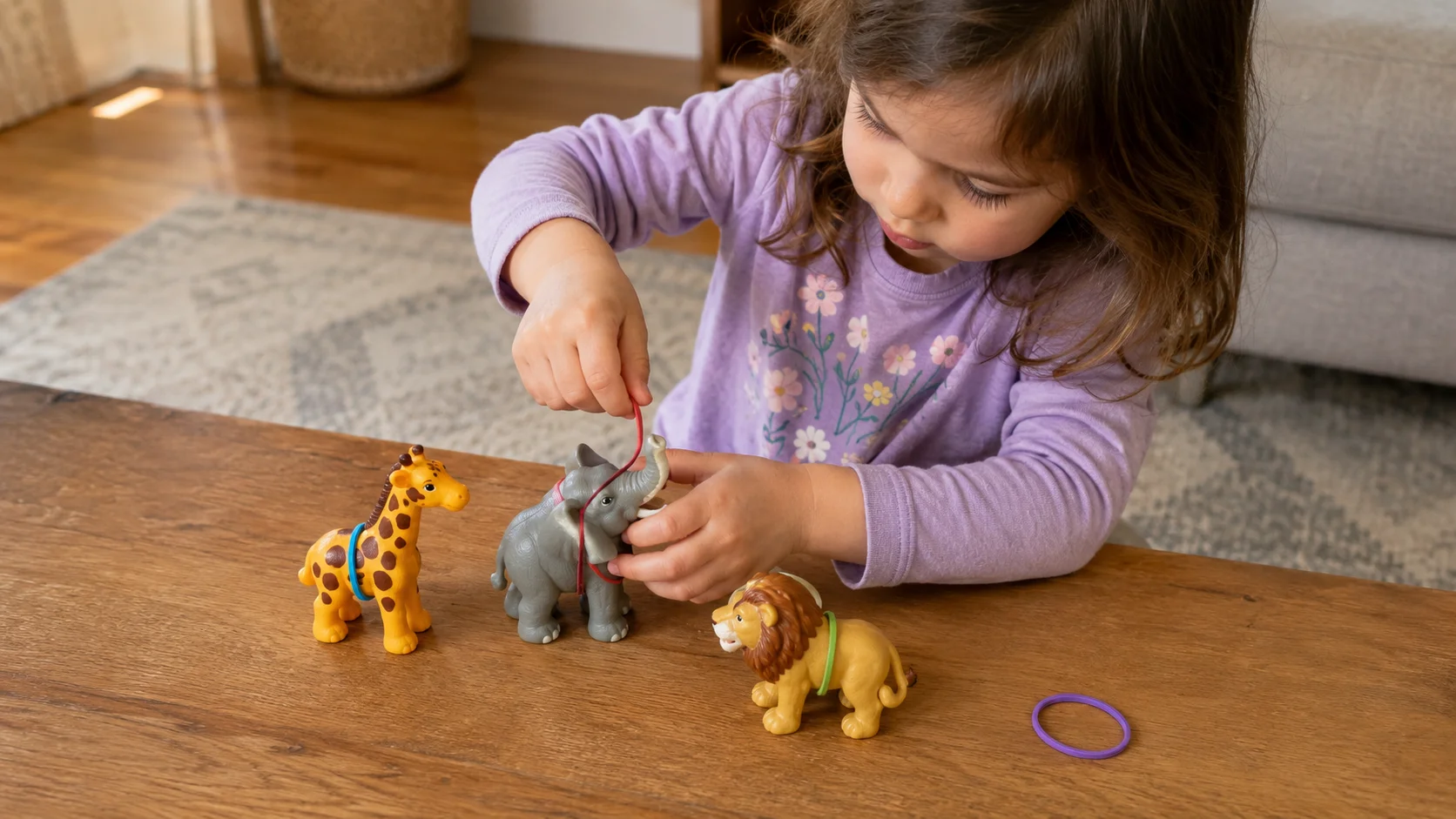
A child pulling a loose rubber band off a plastic toy animal while two banded animals wait on the table.
Today's pick
Loose rubber bands turn toy animals into a careful rescue job.
Start here

The recipe.

Low parent effort
2 things

What you need

  1. 01
    3 plastic toy animals around Fisher-Price size
  2. 02
    3 rubber bands
5 min minimum

Setup

Then start the loop
Step 01
Pick 3 plastic toy animals and 3 rubber bands for the first round; keep extra rubber bands out of reach.
Step 02
Wrap 1 rubber band around each animal between its ears and legs, loose enough that you can slide a fingertip under the band without pulling hard.
Step 03
Put the banded animals in a short line in front of your child, choose one clear spot beside the line for removed bands, and stay close enough to watch the rubber bands.
Then continue
Let your child steady the animal, hook a finger under the band, stretch it over the ears or legs, and drop the freed band on the clear spot.
The loop

How play unfolds.

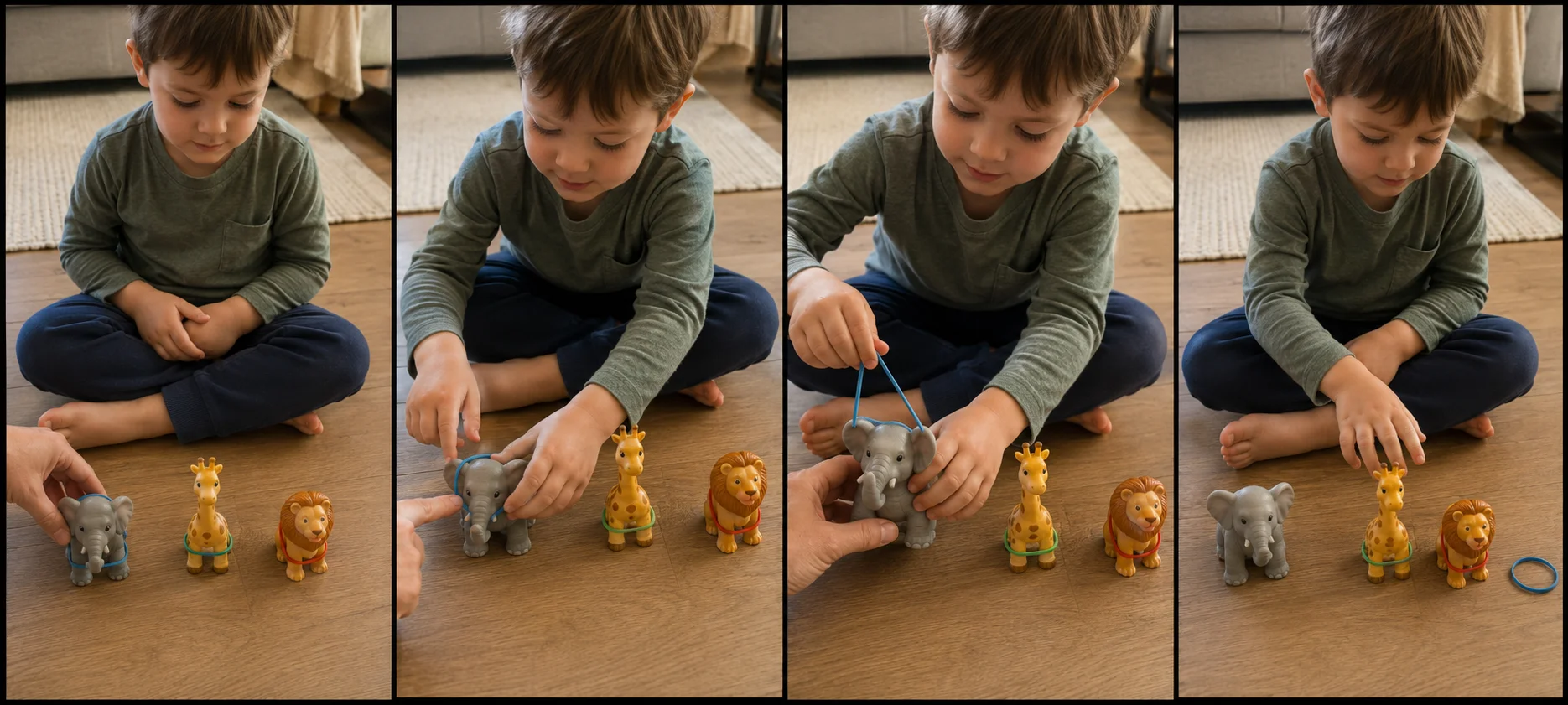
Four panels showing a grown-up setting out banded toy animals, a child pulling one band free, placing the band on a clear spot, and choosing the next animal.
1
Pick up one banded animal, hold it steady, point to the rubber band, and say, "This animal is stuck. Can you rescue it by taking the rubber band off?"
2
If the animal wobbles, hold it still while your child pulls the band.
3
After 1 animal is free, move to the next banded animal.
4
Finish the round when every visible rubber band is off the animals.
5
To reset, wrap the rubber bands loosely back onto the animals and offer another rescue round.

What to say in the moment

Match what you say to what you see.

Prompt ladder
Level 1 (Start)
Can you rescue this animal?
Level 2 (Keep going)
Which animal needs help next?
Level 3 (Stretch)
Can your fingers go slowly?
Level 4 (Extend)
Tell me how this animal got stuck.
If your child seems...
What you'd see
Focused
What to do
Say
"Gentle pull."
Add
Name the animal once.
Extend
Let your child add one short rescue line before choosing the next animal.

Make it easier

Younger end
  • -Use 1 animal with 1 very loose band.
  • -Hold the animal steady while your child pulls the band.
  • -Start the band over one ear or leg before handing over the final pull.

Make it harder

Older end
  • +Let your child choose the rescue order.
  • +Add a second loose band to one animal.
  • +Let your child help rewrap 1 loose band.

If it's not working

If you see
If child ignores it
Hold one animal near your child, wiggle it gently, say, "Help, I'm stuck," and lift the first edge of the rubber band so the rescue is already started.
If you see
If child misuses it
If your child stretches, shoots, mouths, or walks away with a rubber band, pause the game, take the rubber band back, and restart with 1 animal while you hold it steady.
If you see
If child gets frustrated
Switch to the loosest band on the easiest animal, start the band over one ear or leg, and let your child finish the pull.
Skill spotlight

Using both hands together

Two Hand Coordination
Developmental value

This helps children use both hands together to solve a small physical problem. That kind of careful two-hand control shows up in dressing, opening containers, fastening, and handling small toys safely.

Source support

Holding one toy steady while stretching and removing a rubber band fits fine-motor practice with precise finger control, grip adjustment, two-hand coordination, and careful object positioning.

Mechanic evidence

Your child steadies a small animal with one hand while hooking, stretching, and lifting a rubber band with the other hand.

Real-World Transfer
  • - Pulling socks, sleeves, or dress-up clothes.
  • - Holding one object while moving another.
  • - Using gentle hands with stretchy or small objects.
What You'll See
Early. Your child may pull the band while you hold the animal.
Later. Your child may adjust the pull when the band catches and move on to another animal.
Middle. Your child may use one hand to steady the animal and the other hand to pull.
Why it helps
  • Holding the animal with one hand while pulling the band gives each hand a different job.
  • Loose bands create gentle resistance, so your child practices adjusting finger force instead of yanking.
  • Dropping each freed band on the clear spot turns the rescue into a small finish-and-reset routine.

Parent questions

Keep playing

Related play

Activities for ages 3 to 5Fine motor activitiesTwo-hand coordination activities